 XIAODING-TECH

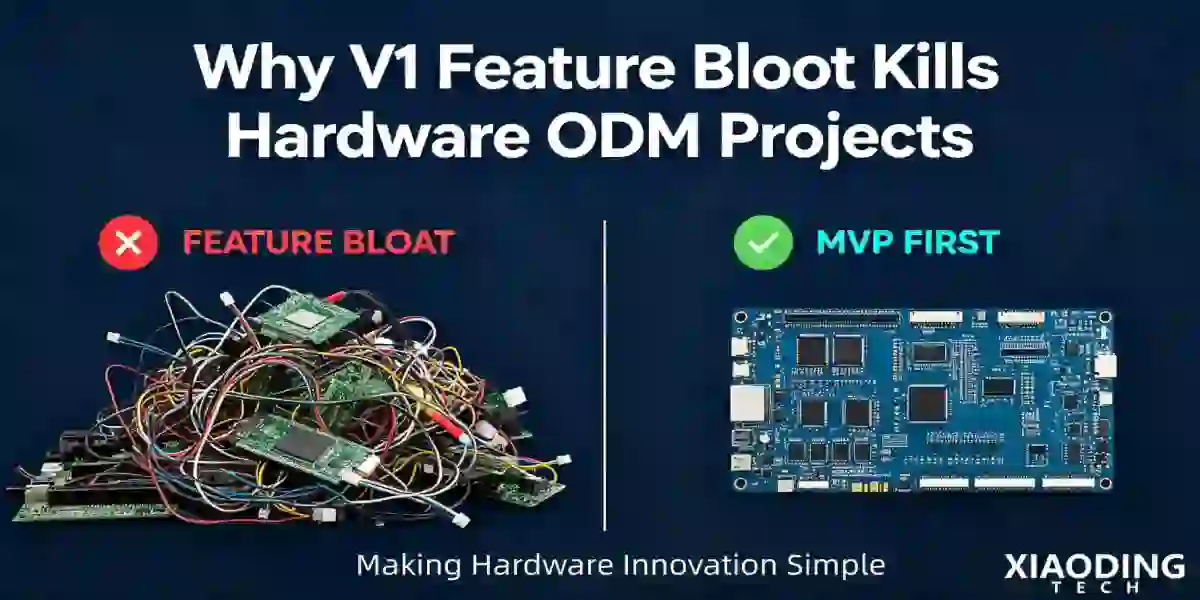
In hardware ODM development, the most expensive mistake is the most common: trying to build everything into Version 1.
At شياو دينغ التكنولوجيا, we often see product teams arrive with a wishlist: wireless connectivity, touch displays, AI sensors, and waterproofing—all in the first prototype. The result? Blown budgets, missed launch windows, and projects that never reach the shelf.
The First Principle of Hardware: Do less in V1 to achieve more in the market.
5 Reasons Multi-Feature V1s Fail
1. Complexity Grows Exponentially
Software iterates in seconds; hardware iterates in weeks. Adding a single feature doesn’t just add a component; it complicates the entire system:
Interference: Antennas disrupt audio; charging circuits distort sensors.
PCB Layout: More features mean more layers and tighter tolerances, increasing the risk of signal integrity issues.
Formula: Development Effort = Feature Count × System Coupling.
2. The BOM Cost Spiral
In the prototyping phase, you have zero pricing leverage. A $1 chip at scale might cost $10 in samples.
Hidden Costs: Adding “waterproofing” doesn’t just add a seal; it doubles the cost of mechanical structures and testing.
The Trap: By the time you reach V1, your Bill of Materials (BOM) often exceeds the target retail price, making the product commercially unviable.
3. The “Certification Wall”
Every feature expands the legal requirements for sale:
Wireless: FCC/CE/RED.
Battery: UN38.3/IEC 62133.
Waterproofing: IP rating verification.
A feature-heavy V1 leads to longer lab cycles and a higher chance of failed retests, delaying your launch by months.
4. Validation Exhaustion
If you have 10 features with 10 scenarios each, you have 100 test cases. Add cross-feature interactions, and you hit 1,000+.
The Risk: Compressed timelines usually mean cutting corners on testing. Shipping an unvalidated product means moving your lab into your customers’ homes—leading to high return rates and brand damage.
5. Scope Creep: The Silent Killer
Hardware rework is expensive. Changing a firmware parameter is easy, but changing a mechanical button to a touch sensor requires new PCB spins and new tooling. Feature-rich V1s are breeding grounds for scope creep, the #1 cause of project cancellation.
Case Study: The “Smart Bottle” Failure
Result: Development stretched from 3 to 9 months. BOM cost rose from $12 to $30. Waterproofing failed three times.
Outcome: The project was cancelled. Had they focused on one core feature (e.g., hydration tracking), they would have hit the market in 90 أيام.
The Xiaoding Tech Strategy: MVP First, Iterate Later
The goal of V1 is not perfection; it is stable mass production and market validation.
1. The V1 Filter
Ask three questions of every feature:
Essential? Does the product exist without it?
Valuable? Is this why the user is paying?
Low Risk? Can it be produced with a high yield rate?
2. Phased Development Roadmap
V1 (MVP): Core features + Stable yield + Target cost. (Validate the market).
V2: High-value add-ons + Experience optimization.
V3: Exploratory features + Ecosystem integration.
3. Time-to-Market vs. Feature Completeness
In hardware, a 3-month delay can mean missing an entire holiday selling season. A lean product that ships on time is infinitely more valuable than a “perfect” product that arrives too late.
💼 Making Hardware Innovation Simple
At شياو دينغ التكنولوجيا, we don’t just help you design products; we help you make manufacturable, profitable, and iterable business decisions. Our 20+ years of engineering expertise ensures your V1 is a stepping stone, not a tombstone.
Stop over-engineering. Start producing.
إذا كان لديك أي إبداع منتج جديد أو مشاريع تطوير الأجهزة القادمة, لا تتردد في الاتصال بنا في أي وقت!
اتصال: شياو دينغ
واتساب: +86-15013883553
بريد إلكتروني: contact@xiaodingtech.cn
Official Website: www.xiaodingtech.cn
We will arrange a dedicated team to follow up and evaluate your project professionally.Let’s turn your great ideas into market-competitive electronic products together.🚀