 XIAODING-TECH

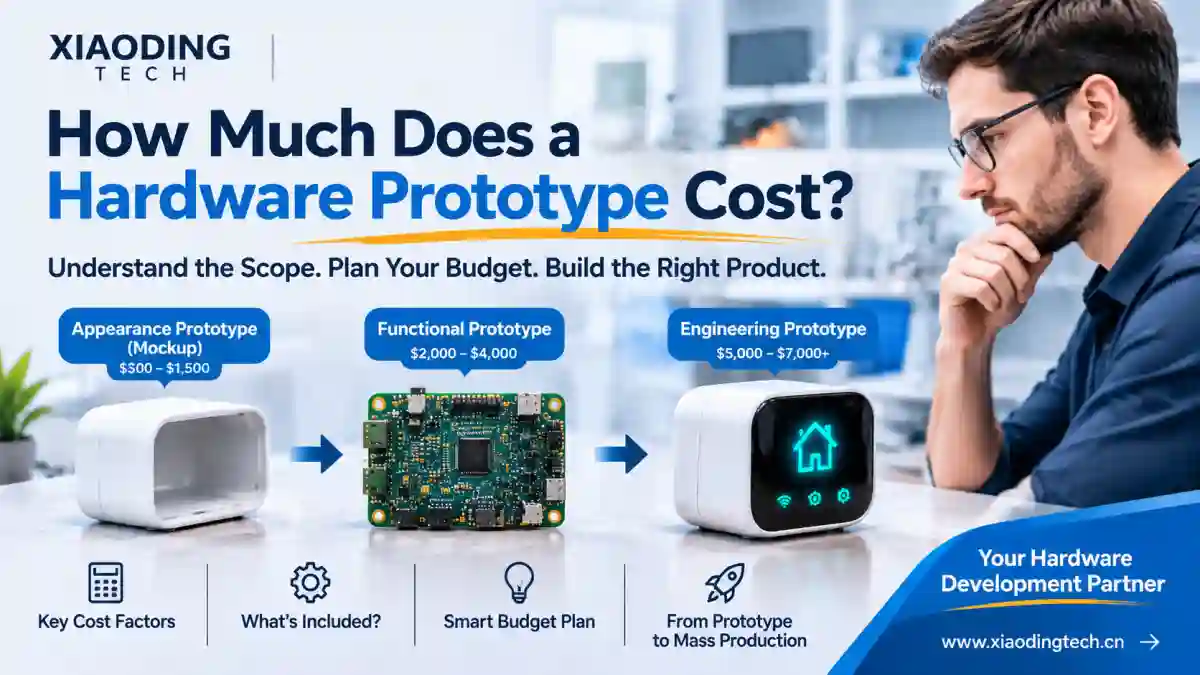
How Much Does a Hardware Prototype Cost? A Complete Guide to Electronic Product Development
Understand Prototype Types, Engineering Costs, Development Scope, and Budget Planning
If you are planning to develop a new electronic product, one of the first questions you may ask is:
How much does a hardware prototype cost?
The answer depends on what you need to build.
A simple 3D-printed appearance model, a functional electronic prototype, and a fully integrated engineering prototype involve very different levels of work. Their costs can vary significantly depending on product complexity, custom electronics, mechanical design, firmware development, testing, and the number of development iterations.
In general, a hardware prototype quotation should be evaluated based on engineering scope, development deliverables, testing requirements, and project objectives—not simply the number of physical samples.
This guide explains what affects hardware prototype costs, how different prototype types compare, what should be included in a development quotation, and how to plan your budget from the first prototype to mass production.
Réponse rapide: What Determines Hardware Prototype Cost?
The cost of developing a hardware prototype is mainly determined by six factors:
- Product complexity: The number of functions, electronic systems, sensors, and mechanical components.
- Mechanical design: Enclosure design, structural engineering, materials, and fabrication methods.
- Electronics development: Component selection, circuit design, Disposition des circuits imprimés, and debugging.
- Firmware development: Embedded software, communication, control logic, and system integration.
- Prototype fabrication: 3D printing, CNC machining, PCB production, component assembly, and finishing.
- Testing and revisions: Functional validation, troubleshooting, design changes, and additional prototype builds.
A basic appearance model may require relatively little engineering, while a custom engineering prototype can involve several disciplines working together.
The most reliable way to estimate hardware prototype development cost is to define the required functions, technical scope, expected deliverables, and validation objectives before requesting quotations.
1. What Are the Different Types of Hardware Prototypes?
Before discussing cost, it is important to understand that not all prototypes serve the same purpose.
Most electronic product development projects involve three broad prototype categories.
1.1 Appearance Prototype: Validate the Product’s Look and Feel
An appearance prototype is mainly used to evaluate the external design and physical dimensions of a product.
It helps answer questions such as:
- Does the product look as expected?
- Are the dimensions and proportions correct?
- Is the enclosure comfortable to hold?
- Are the buttons, openings, and interfaces positioned correctly?
- Does the product match the intended industrial design?
Common fabrication methods include:
- 3D printing
- CNC machining
- Basic surface finishing
- Simple mechanical assembly
An appearance prototype does not necessarily contain functional electronics. It may be only a physical model for visual and dimensional evaluation.
Best for: Early concept reviews, industrial design evaluation, presentations, and basic structural checks.
1.2 Prototype fonctionnel: Verify Whether the Product Works
A functional prototype is designed to demonstrate the product’s core functions.
Depending on the project, it may include:
- Electronic component selection
- Sensors and communication modules
- PCB design or development boards
- Firmware development
- Power management
- Basic mechanical integration
- Functional debugging
For example, a smart electronic device may need to demonstrate sensor readings, wireless communication, display functions, and user controls.
A functional prototype helps verify technical feasibility. However, it does not automatically prove long-term reliability, regulatory compliance, or mass-production readiness.
Best for: Core function verification, technical feasibility, early demonstrations, and initial user testing.
1.3 Engineering Prototype: Validate the Integrated Product Design
An engineering prototype combines mechanical, electronic, and software development into a more complete product.
Depending on the agreed development scope, it may include:
- Industrial and mechanical design
- Enclosure and internal structural development
- Electronic circuit and PCB design
- Firmware development and debugging
- Component integration
- Mechanical and electronic compatibility checks
- Functional testing and optimization
- Engineering documentation
- Design improvement recommendations
The purpose is to identify engineering problems and establish a stronger foundation for the next development stage.
An engineering prototype is not automatically production-ready. Further design validation, reliability testing, compliance assessment, tooling, and production preparation may still be required.
Best for: Custom electronic products, hardware startups, product brands, and projects preparing for tooling or manufacturing.
Prototype Type Comparison
| Comparison | Appearance Prototype | Prototype fonctionnel | Engineering Prototype |
|---|---|---|---|
| Main objective | Verify appearance | Verify core functions | Validate integrated design |
| Physical enclosure | Usually | Sometimes | Usually |
| Custom PCB | Not necessarily | Sometimes | Often, depending on scope |
| Micrologiciel | Not required | Often | Usually, if required |
| System integration | Limited | Partial or basic | More comprehensive |
| Engineering testing | Basic checks | Functional checks | Agreed engineering validation |
| Manufacturing preparation | Limited | Limited | May include recommendations |
The exact scope varies by product and supplier. Always confirm what each prototype package actually includes.
2. How Much Does Each Type of Hardware Prototype Cost?
There is no single standard price for each prototype category.
A supplier may quote a relatively low price for a simple enclosure model, while another quotation may include custom PCB development, micrologiciel, mechanical engineering, integration, and testing.
These are not equivalent services.
For example, consider three hypothetical project requirements:
Project A: Appearance model
The customer has completed the industrial design and only needs a physical enclosure to evaluate the dimensions and appearance.
The supplier mainly provides fabrication and basic assembly.
Project B: Functional prototype
The customer needs to demonstrate several electronic functions using existing modules, basic firmware, and a simple enclosure.
The supplier needs to handle component integration and functional debugging.
Project C: Custom engineering prototype
The customer has a product concept but requires mechanical engineering, custom electronics, firmware development, prototype fabrication, system integration, and agreed testing.
The supplier needs to coordinate several engineering disciplines.
The three projects require different resources, schedules, and technical responsibilities.
Therefore, do not compare prototype quotations without comparing their development scope.
3. What Factors Affect Electronic Hardware Prototype Development Cost?
3.1 Product Complexity
A simple electronic accessory and a connected smart device may have very different engineering requirements.
Costs can increase when a product involves:
- Multiple electronic modules
- Wireless communication
- Sensors and control systems
- Battery charging and power management
- Displays and user interfaces
- Motors, heating elements, or other high-power components
- Mobile applications or cloud communication
- Complex mechanical structures
The more systems that need to work together, the more integration and debugging work may be required.
3.2 Mechanical and Industrial Design
If you already have detailed mechanical drawings and a confirmed industrial design, the supplier may be able to focus on engineering implementation.
If you only have a product idea, reference images, or a rough sketch, additional work may be required to define:
- Product dimensions
- Internal component layout
- Enclosure structure
- Materials and manufacturing methods
- Assembly methods
- Mechanical interfaces
- Product appearance
The quotation should clarify whether industrial design, mechanical engineering, enclosure fabrication, and structural revisions are included.
3.3 Electronics and PCB Development
Electronic development costs depend on the product’s technical requirements.
For example:
- Using a mature development board may reduce initial design work.
- A custom PCB requires schematic design, layout, fabrication, assembly, and debugging.
- Products involving wireless communication, battery management, or multiple sensors may require additional engineering and validation.
Remember that PCB fabrication cost is only one part of electronics development. Engineering design and debugging also need to be considered.
3.4 Firmware Development
Many electronic products require embedded firmware to control their functions.
Firmware development may include:
- Microcontroller programming
- Sensor data processing
- Communication protocols
- Device control logic
- Display and button interaction
- Power management
- Firmware debugging and optimization
If a mobile application, cloud platform, or AI function is required, identify it as a separate development scope unless it is explicitly included.
3.5 Prototype Fabrication and Assembly
The fabrication method affects both cost and development time.
Common methods include:
- 3D printing for early enclosure models
- CNC machining for more precise structural parts
- PCB fabrication and assembly
- Silicone or other soft tooling for selected parts
- Prototype assembly and finishing
The best fabrication method depends on the required accuracy, material, appearance, function, and testing purpose.
3.6 Testing and Design Revisions
The first prototype rarely solves every engineering problem.
Testing may reveal issues involving:
- Mechanical fit
- Electrical performance
- Communication stability
- Battery life
- Heat dissipation
- Firmware behavior
- User operation
Each additional revision may require new components, PCB fabrication, enclosure modifications, assembly, and engineering time.
A quotation should state how many prototype builds or revision rounds are included and how additional changes will be handled.
4. What Should Be Included in a Hardware Prototype Quotation?
A professional hardware prototype quotation should explain the work involved, not just provide a total price.
The following table shows common cost categories.
| Cost category | Possible deliverables |
|---|---|
| Product engineering | Technical planning and engineering design |
| Industrial and mechanical design | 3D models, drawings, enclosure structure |
| Electronics development | Schematics, Disposition des circuits imprimés, sélection des composants |
| PCB production | PCB fabrication and assembly |
| Firmware development | Embedded code and functional debugging |
| Prototype fabrication | 3D printing, CNC machining, finishing |
| System integration | Mechanical and electronic integration |
| Testing and validation | Functional checks and agreed test records |
| Project coordination | Technical communication and development management |
Not every project requires every item.
Before starting, clarify the following deliverables:
- How many physical prototype units will be delivered?
- Are mechanical drawings and 3D files included?
- Are electronic schematics and PCB files included?
- Is firmware development included?
- Are source code and design files transferable?
- Are test records included?
- Are design revisions included?
- Are manufacturing preparation recommendations included?
Intellectual property ownership, source-code access, design-file delivery, and usage rights should be agreed in writing before development begins.
5. Why Do Hardware Prototype Quotations Differ So Much?
Imagine that you send the same product concept to three suppliers.
| Supplier | Quotation | Possible development scope |
|---|---|---|
| Supplier A | $800 | Basic appearance model |
| Supplier B | $2,500 | Functional demonstration using existing modules |
| Supplier C | $5,000–$7,000 | Broader custom engineering prototype scope |
These figures are illustrative examples only. They are not market averages, fixed price ranges, or guaranteed packages.
The suppliers may be quoting for completely different deliverables.
Supplier A may only fabricate an enclosure. Supplier B may assemble existing electronic modules and demonstrate core functions. Supplier C may include custom electronics, micrologiciel, mechanical engineering, integration, debugging, and agreed tests.
A higher quotation is not automatically better, and a lower quotation is not automatically a better deal.
Compare the following before making a decision:
- Engineering work included
- Number of prototype units
- Customization requirements
- Testing and validation scope
- Number of revisions
- Technical documentation
- Intellectual property arrangements
- Development schedule
- Excluded costs and potential additional charges
The real value of a prototype quotation is determined by the engineering results and deliverables—not just the price.
6. How Can You Reduce Hardware Prototype Development Costs?
Reducing prototype costs does not necessarily mean choosing the cheapest supplier.
It means avoiding unnecessary engineering work and expensive redesigns.
Step 1: Define the Core Product Functions
List the essential functions that the first prototype must demonstrate.
Separate must-have functions from optional features.
Avoid developing every future feature in the first prototype unless it is necessary to validate the product.
Step 2: Prepare Basic Product Specifications
Before requesting quotations, provide:
- Product concept and application scenario
- Target users
- Main functions
- Reference images or sketches
- Approximate dimensions
- Power supply requirements
- Connectivity requirements
- Target market
- Expected prototype quantity
Clearer specifications help suppliers estimate the actual engineering work.
Step 3: Use Mature Components Where Appropriate
Existing electronic modules and proven components may reduce initial development time.
However, they should still be checked against the product’s size, performance, power consumption, availability, and future production requirements.
Step 4: Separate Prototype Fabrication from Production Tooling
The first prototype does not always need production tooling or final materials.
Use appropriate prototype fabrication methods to validate the design before committing to expensive molds or production processes.
Step 5: Agree on Testing Requirements in Advance
Define what the prototype must demonstrate and how success will be evaluated.
Clear acceptance criteria help reduce misunderstandings and unnecessary revision cycles.
Step 6: Plan the Full Development Budget
Do not spend your entire budget on the first prototype.
Consider the costs of later engineering revisions, tooling, attestation, pilot production, and mass production.
A prototype is one stage of product development, not the final destination.
7. What Happens After the Hardware Prototype?
A working prototype does not mean that a product is ready for mass production.
A typical electronic hardware development project may involve the following stages:
| Development stage | Main activities | Key objective |
|---|---|---|
| 1. Product definition and evaluation | Requirements review, feasibility assessment, development planning | Confirm project direction |
| 2. Engineering development | Mechanical design, electronics, micrologiciel, integration | Build the prototype |
| 3. Design validation and optimization | Testing, debugging, design revisions | Improve product performance |
| 4. Tooling and mold development | Mold design, tooling fabrication, sample inspection | Prepare production tooling |
| 5. Pilot production | Trial manufacturing, process verification, quality checks | Identify production issues |
| 6. Mass production | Fabrication, inspection, packaging, delivery | Produce products at scale |
The actual sequence and schedule depend on product complexity, testing requirements, tooling strategy, and supply-chain conditions.
A development partner should understand not only how to build a prototype, but also what needs to happen before mass production.
8. How to Choose the Right Hardware Prototype Development Partner
Choosing a prototype supplier is an important decision because the early engineering work can influence the entire product development process.
Before selecting a partner, consider these questions:
- Does the supplier understand your product category?
- Can the supplier support mechanical and electronic development?
- Can they handle PCB and firmware development if required?
- Do they have experience integrating different product systems?
- Can they explain the engineering scope clearly?
- Do they provide a realistic development schedule?
- Can they support testing and design optimization?
- Can they coordinate tooling and manufacturing preparation?
- Are communication, project ownership, and payment terms clear?
A good development partner should be able to explain technical risks, identify missing requirements, and help you make practical engineering decisions.
The goal is not simply to obtain a physical sample. It is to move the product toward a technically viable and commercially realistic solution.
9. Hardware Prototype Development with XIAODING TECH
XIAODING TECH is an electronic hardware product development partner based in Shenzhen, Chine.
We support global product founders, startups, and brands that need engineering support to turn product concepts into physical electronic products.
Our experience covers more than 500 product cases.
Depending on project requirements, our services may include:
- Product concept and technical evaluation
- Industrial and mechanical design
- Electronic circuit and PCB development
- Firmware development
- Prototype fabrication and assembly
- Functional integration and debugging
- Engineering testing and optimization
- Supply-chain coordination
- Tooling and mass production preparation
Our approach focuses on connecting product requirements, engineering development, prototype validation, and manufacturing preparation.
What Types of Projects Are a Good Fit?
We are most interested in projects with a clear development direction and a realistic plan for commercial development.
A good project usually has:
- A clearly defined product concept
- Basic functional requirements
- A target customer group or application scenario
- A realistic development budget
- A reasonable project timeline
- A clear intention to continue toward tooling, pilot production, or mass production
We value long-term cooperation and prefer to work with customers who view product development as a joint engineering process rather than simply purchasing the cheapest prototype.
How Does the Project Evaluation Process Work?
Our initial project review helps both sides understand the product concept, development requirements, technical complexity, and expected objectives.
A typical process includes:
1. Submit project information
Provide the product concept, reference images, main functions, target market, and expected development schedule.
2. Initial project review
We review the available information and identify key questions about the product and its development requirements.
3. Technical communication
Both sides clarify the main functions, technical challenges, expected deliverables, and project direction.
4. Development quotation
A quotation is prepared based on the agreed development scope, assumptions, deliverables, and schedule.
5. Development agreement
Once both sides agree on the project scope and commercial terms, engineering work can begin.
A preliminary project discussion is not the same as a complete engineering assessment. Detailed evaluation and quotation depend on the information provided and the agreed scope.
10. Request a Hardware Prototype Development Evaluation
Planning to develop a new electronic product?
Before choosing a supplier, make sure you understand what your prototype needs to prove, what engineering work is required, and what comes after the prototype stage.
XIAODING TECH welcomes inquiries from global product founders, startups, and brands looking for an electronic hardware development partner in Shenzhen, Chine.
To help us understand your project, please prepare:
- Product concept or reference images
- Main functions and technical requirements
- Target application and customer group
- Expected prototype quantity
- Target development schedule
- Estimated project budget
- Your plan after prototype validation
Let’s turn your product idea into an engineered product with a clear path toward manufacturing.
Visit: https://www.xiaodingtech.cn/free-evaluation-for-consumer-electronics-innovation-projects/
Frequently Asked Questions About Hardware Prototype Costs
How much does a hardware prototype cost?
There is no fixed price for all hardware prototypes. The cost depends on product complexity, mechanical design, electronics, micrologiciel, fabrication, testing, and the number of revisions. A basic appearance model requires a different scope from a custom engineering prototype.
What is the difference between an appearance prototype and a functional prototype?
An appearance prototype is mainly used to evaluate the product’s physical appearance, dimensions, and structure. A functional prototype is designed to demonstrate selected product functions using electronics, components, and firmware where required.
Why is a custom electronic prototype more expensive than a 3D-printed model?
A 3D-printed model may only demonstrate the product’s appearance. A custom electronic prototype may also require PCB design, sélection des composants, firmware development, mechanical integration, debugging, and testing. These engineering activities add to the development cost.
Does a hardware prototype quotation include PCB design?
Not necessarily. Some quotations only include PCB fabrication and assembly using customer-provided design files. Others include schematic design, Disposition des circuits imprimés, sélection des composants, fabrication, assembly, and debugging. Always confirm the scope.
Does a working prototype mean the product is ready for mass production?
No. A working prototype demonstrates certain functions under specific conditions. Additional design validation, reliability testing, compliance assessment, manufacturing engineering, tooling, and pilot production may still be required.
How many prototypes should I build?
The required quantity depends on the project. One prototype may be enough for an initial demonstration, while engineering debugging, performance testing, or user evaluation may require multiple units. Agree on the quantity and purpose before development begins.
Can I reduce prototype costs by using existing electronic modules?
Oui, in some cases. Mature modules and development boards can reduce initial design work. However, they may introduce limitations in size, power consumption, performance, interfaces, or production cost. The best choice depends on the product requirements.
Does prototype development include mold costs?
Not automatically. Prototype fabrication and production tooling are usually separate development activities. Confirm whether the quotation includes 3D printing, CNC machining, prototype tooling, or mass-production injection molds.
What information should I prepare before requesting a prototype quotation?
Prepare your product concept, main functions, reference images, target dimensions, power requirements, connectivity requirements, target market, expected prototype quantity, schedule, and estimated budget. The more clearly you define the project, the more accurately a supplier can evaluate it.
Should I choose the cheapest hardware prototype supplier?
Not based on price alone. Compare the engineering scope, deliverables, testing, revision policy, communication, and relevant product experience. A low initial quotation may exclude important work that you will need to pay for later.
Final Takeaway
The cost of a hardware prototype is determined by what you need to develop and prove—not simply by the number of physical samples.
Define the scope first, compare deliverables carefully, and plan the budget around the complete journey from product concept to manufacturing.
A well-planned prototype is not just a sample. It is an important engineering step toward building a successful electronic product.
Remark:
If you have any new product creativity or upcoming hardware development projects, feel free to contact us anytime!
Contact: XIAODING
WhatsApp: +86-15013883553
E-mail: contact@xiaodingtech.cn
We will arrange a dedicated team to follow up and evaluate your project professionally.Let’s turn your great ideas into market-competitive electronic products together.🚀