 XIAODING-TECH

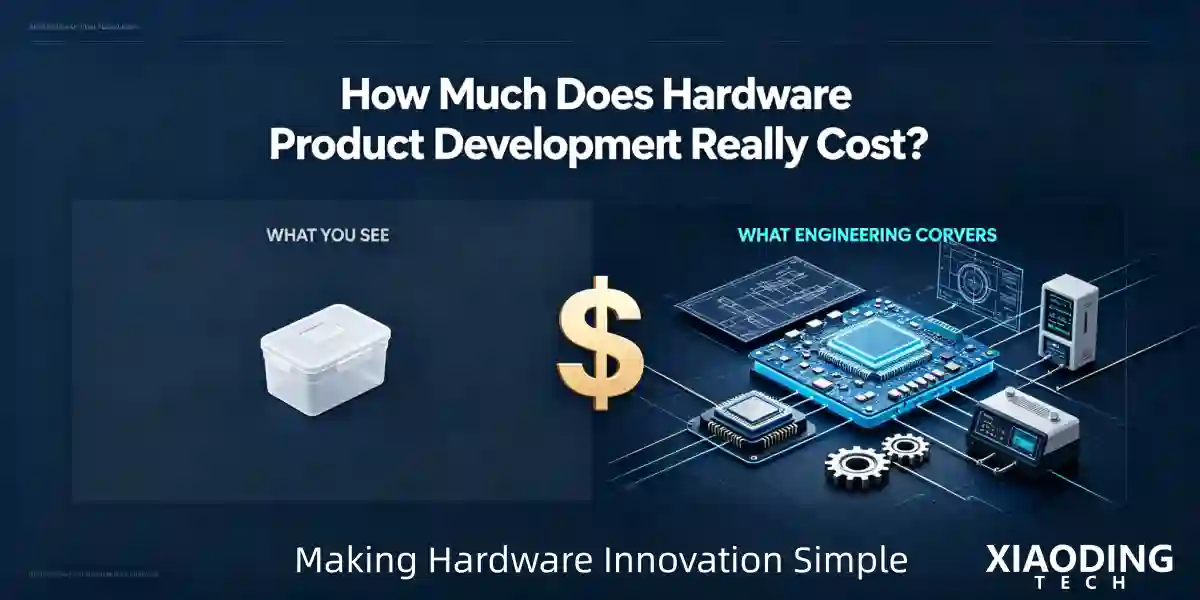
A founder’s guide to understanding, benchmarking, and evaluating ODM R&D quotes.
Hardware product development costs $5,000–$15,000 for a typical ODM R&D engagement in China, $30,000–$50,000 from US or European engineering firms, and as little as $300–$1,000 for copycat “sample shops” with no design capability. The difference is engineering depth — not markup. Full R&D covers industrial design, structural design, PCB design, prototypage, and testing. This guide breaks down exactly where your money goes, how to benchmark a quote, and why the cheapest option is usually the most expensive one.
A True Story
Last week, a client from England wrote to us: “Dear, I believe $5,200 is a very high cost.”
His product is a car fragrance diffuser — a device that sits in a car and releases perfume on a precise schedule. In his view, it’s “a plastic shell, a small pump, and a battery.” Why should it cost five thousand dollars?
I understand his reaction. But I also want him to see one fact: the same project, quoted by a US or European engineering firm, would cost $30,000–$80,000. Our $5,200 is the floor price of the entire industry.
The problem isn’t the price. It’s the perception gap.
1. You Think You’re Buying Samples. You’re Actually Buying Engineering.
This is the most common misunderstanding.
What the client sees: a box that sprays perfume. What engineers see:
表格
| Phase | Actual Work | Duration |
|---|---|---|
| Dessin industriel | Exterior styling, ergonomics, CMF (color/material/finish) | 7 days |
| Structural Design | Internal stacking, leak-proof sealing, airflow channel, mounting | 7 days |
| Circuit Design | Schematic, Disposition des circuits imprimés, EMC headroom | 14 days |
| Prototype Fabrication | 3D printing / CNC hand samples, soft tooling | 3–7 days |
| Assembly & Testing | Integration, spray calibration, high-temperature testing, debugging | 3–7 days |
| Delivery | Samples, documentation, international express | 15-20days |
$5,200 doesn’t buy you “a few samples.” It buys you the entire engineering pipeline that produces them. The sample is just the end product of that pipeline — like paying for the meal, not just the bowl.
2. Why “Simple-Looking” Products Cost More to Develop
This is the hardest point for clients to accept: the smaller and simpler a product looks, the more expensive it is to engineer.
Because a simple exterior hides a mountain of non-obvious work:
- Micro-pump selection — it must spray little, spray evenly, and never clog. You may test five suppliers before finding one that works.
- Spray calibration — 0.04 ml per spray at ±15% precision takes round after round of testing to nail down.
- High-temperature leak-proofing — a car cabin can reach 70°C in summer. Perfume expands under heat. Get the sealing wrong and you have a leak disaster.
- Airflow channel design — fragrance must diffuse evenly through the cabin. That takes CFD simulation and real-world iteration.
- Battery safety in heat — automotive environments demand far stricter thermal and charging safety than desktop products.
- Noise control — a cabin is quiet. If the micro-pump hums, users notice immediately.
- Button feel — it must click with tactile confirmation. The mold gets revised until it’s right.
Each item above is a full “design → sample → test → rework” loop. The smaller the product, the less room for error — and the higher the engineering cost. A large appliance tolerates rough edges. A palm-sized car diffuser doesn’t.
3. Three Common Misconceptions
Misconception #1: Comparing “Sample Cost” with “Engineering Service”
Recherche “car fragrance diffuser manufacturer” on Alibaba and you’ll find $300 quotes. But those are private-label copies of existing designs — no design work, no development, no testing. Just a new logo on an existing shell.
What you need is design from zero to one: no existing solution, every trace, every curve, every line of firmware created from nothing.
$300 buys replication. $5,200 buys creation. They are not the same product.
Misconception #2: Looking at the Upfront Number, Not the Per-Unit Math
$5,200 looks like a lot. Do the math:
- At a $29.9 retail price with 50% gross margin, you recover the R&D cost after selling just 350 unités
- Spread across 20,000 units in mass production, R.&D adds only $0.26 per unit
- Xiaodingtech supports product innovation and research and development expenses with a 50% refund policyxiaodingtech ODM R&D Politique de remise des coûts: Donner du pouvoir aux innovateurs mondiaux
- With our 50% R.&D refund at volume, the real per-unit cost is $0.13
R.&D is a one-time investment that becomes negligible at production scale. What actually determines your profit is whether you can build a product that sells — and that depends entirely on the engineering you’re hesitating to pay for.
Misconception #3: Technology Isn’t “Worth It”
Founders will happily pay $5,000 for a product video, yet call $5,000 of engineering “too expensive.”
But a video captures a product that already exists. Engineering creates the product that doesn’t exist yet. Without the latter, what would the video even film?
Engineers don’t sell hours. They sell the ability to turn an idea in your head into a sellable object. That ability was paid for with years of failures, rework, and trial-and-error. It shouldn’t be priced by the gram.
4. Why the Same Project Costs 10x More in Different Markets
表格
| Market | Typical R&D Quote | Why the Difference |
|---|---|---|
| US / European engineering firms | $30,000–$50,000 | Higher labor costs, heavy process overhead, IP risk premium |
| Tier-1 China ODM | $5,000–$15,000 | Dense supply chain, engineering talent pool, efficiency |
| “Sample shops” | $300–$1,000 | Copy capability only — no design capability |
When a China ODM quotes $5,200, it’s not “making money off you.” It’s offering the world’s lowest engineering cost for the full service. The same deliverable costs 6x more in another country.
5. How to Evaluate an R&D Quote
Three tests for any founder evaluating a hardware quote:
- Look at scope, not the number — Does the quote itemize ID / structure / PCB / prototype / testing?
- Look at the team, not the price — Do they have mass-production cases? Factory photos? Client references? The cheapest quote is usually the most expensive one — rework costs come back doubled.
- Look at risk-sharing, not promises — Are milestone payments available? Is the refund policy in the contract? A supplier willing to share your risk is a supplier worth trusting.
Xiaodingtech Payment Method
R.&D stage: 100% payment upfront
Mold stage: segmented payment
First batch of orders: segmented payment
6. To Every Founder Hesitating Right Now
I’ve watched too many projects die on “it’s too expensive”:
- Founders who chose a cheap sample shop, ended up with a design that couldn’t be mass-produced, then paid double to a professional team to start over.
- Founders who delayed the decision, and lost the market window to competitors.
- Founders who cut testing from the budget, launched with field failures, and killed their brand in its first quarter.
Money you save will find its way back — at a higher price.
R.&D isn’t an expense. It’s an investment in the shortest path from “idea” à “sellable.” A car fragrance diffuser with $5,200 in R&D — is that expensive?
No. What’s expensive is missing the market window. What’s expensive is building a product nobody buys. What’s expensive is staying stuck at “idea” forever. The road to “sellable” may be the most valuable $5,200 you ever spend.
FAQ
Q: Why is hardware development so expensive? A: Full R&D covers five disciplines — industrial design, structural design, PCB design, prototypage, and testing. A simple-looking product hides months of iteration: calibration, leak-proofing, thermal safety, and acoustic tuning.
Q: How much does hardware product development cost? A: China ODM: $5,000–$15,000. US/Europe: $30,000–$80,000. Copycat sample shops: $300–$1,000 with no design capability.
Q: What’s the difference between ODM and OEM? A: ODM (Original Design Manufacturer) designs and manufactures products for brands — full engineering ownership from concept to mass production. OEM only manufactures to the client’s existing design.
Q: How long does hardware development take? A: A button-controlled MVP reaches prototype in 6–8 weeks. A Bluetooth + app version takes 12–16 weeks. Add 4–8 weeks for certification.
Q: How do I evaluate an ODM quote? A: Check three things: itemized scope (IDENTIFIANT / structure / PCB / prototype / testing), proven mass-production cases, and milestone payment terms.
Xiaodingtech Payment Method
R.&D stage: 100% payment upfront
Mold stage: segmented payment
First batch of orders: segmented payment
Xiaodingtech — Making Hardware Innovation Simple. We help product innovators turn ideas into manufacturable, profitable, iterable hardware. From your idea to your success.
If you have any new product creativity or upcoming hardware development projects, feel free to contact us anytime!
Contact: XIAODING
WhatsApp: +86-15013883553
E-mail: contact@xiaodingtech.cn
Site officiel: www.xiaodingtech.cn
We will arrange a dedicated team to follow up and evaluate your project professionally.Let’s turn your great ideas into market-competitive electronic products together.🚀