 XIAODING-TECH

 In the competitive overseas consumer electronics, casă inteligentă, and portable outdoor hardware markets, countless hardware startups and D2C brand founders struggle with failed product launches. Many new hardware products fail even after huge investment in product R&D, mold tooling, global certification, and mass production. Unlike large tech enterprises, emerging overseas hardware brands lack mature supply chain support, organic brand traffic, and sufficient cash flow for repeated trial and error. Hardware product development for global startups has a very low error tolerance, making systematic optimization critical for market success.
By analyzing hundreds of failed global hardware product launch cases, we found that most hardware development failures are not due to poor technology or product performance. Instead, they stem from four key pain points in overseas hardware business: inaccurate product market fit for global users, unstable supply chain delivery and poor quality control, over-reliance on single sales channels that restrict business scaling, and inadequate global compliance and cash flow management. Successful overseas hardware development is a complete commercial system, not just technical R&D work. This professional guide helps overseas product managers and new hardware brand founders identify core failure reasons and implement proven strategies to improve hardware development success rate and achieve sustainable global business scaling.
1. Optimize Hardware Product Definition: Fix Poor Market Fit for Global Users
The biggest sunk cost in global hardware development is launching a technically advanced product with poor market fit. This is the leading cause of failed overseas hardware startup launches worldwide. Many hardware product designers focus on technical upgrades, competitor feature copying, and creative iteration, while ignoring real global user pain points, overseas usage scenarios, and cross-border purchasing behavior. This self-centered product development leads to high-spec hardware products that fail to gain market traction and generate sales in global markets.
Most startups fall into three typical traps. First, they blindly upgrade functions based on top-selling overseas competitors, adding low-frequency features that raise BOM costs and tooling expenses. Second, they adopt a one-size-fits-all product design without regional localization, ignoring differences in voltage standards, climates, user habits, and aesthetic preferences between Europe, America, Southeast Asia, and other regions. Third, they launch R&D without user validation, solving imaginary problems rather than real market demands. In the hardware industry, every development step without market validation equals invalid investment.
Actionable Optimization Strategies
1. Verify market demands before launching R&D. Reverse the traditional “develop first, verify later” model. In the project initiation phase, conduct in-depth market research via overseas social media surveys, core user interviews, competitor negative review analysis, and community testing. Lock in 1 to 2 high-frequency, high-pain, high-paying user core demands. Cut all redundant low-frequency features and adopt subtractive product development to control costs and avoid invalid innovation. Apply the MVM (Minimum Viable Milestone) framework to verify market, technical, and commercial risks phase by phase.
2. Achieve in-depth regional localization adaptation. Customize products for target overseas markets, including local voltage standards, climate adaptability, and usage scenarios. Align product design with overseas users’ preference for minimalism and practicality. Pre-match mandatory certifications such as CE, FCC, and RoHS in the early design stage. Avoid directly copying domestic products for overseas sales and prevent post-launch rectification losses.
3. Build clear value positioning and differentiation. Every hardware iteration must correspond to a clear user purchasing reason. Define core competitive advantages at the initial stage, whether it’s cost performance, niche scenario specialization, user experience upgrade, or lightweight portability. Deliver clear differentiation to help users understand why your product outperforms competitors and eliminate self-centered R&D.
2. Fix Supply Chain & Mass Production Issues: Eliminate Delivery Delays & Quality Defects
A core rule of the hardware industry: A successful prototype does not equal a successful product; stable mass production does. Countless new overseas brands fail at the mass production and delivery stage. Perfect-performing prototypes often suffer from high defective rates, inconsistent batch quality, material shortages, and delivery delays after mass production. Combined with cross-border logistics pressure, overseas warehouse turnover, and seasonal sales deadlines, minor supply chain errors will escalate into fatal brand crises.
Startups commonly suffer from severe supply chain drawbacks: over-reliance on a single supplier leading to stockouts and price hikes; skipping NPI (New Product Introduction) pilot runs and jumping straight to mass production, resulting in hidden process and quality risks; incomplete cross-border quality control systems causing transportation damage and batch failures; insufficient delivery buffers leading to missed peak sales seasons like Black Friday and Christmas, ultimately causing overstock and capital losses.
Actionable Optimization Strategies
1. Adopt dual-supplier mechanism to avoid stockout risks. Establish a “primary + backup” supplier system for core electronic components, structural parts, and customized packaging materials. Lock in stable pricing and delivery cycles with long-term cooperation agreements. Prepare alternative materials to hedge against industry shortages, price fluctuations, and logistics congestion, ensuring continuous mass production.
2. Follow standardized NPI verification processes. Strictly implement the workflow: prototype verification → engineering trial production → small-batch pilot run → large-scale mass production. Never skip trial production stages. Optimize assembly craftsmanship and product yield through small-batch testing, fixing hidden issues such as system crashes, overheating, assembly defects, and instability. Large-scale production can only be launched when the yield rate stabilizes above 95%. Complete DFM manufacturability review and FMEA failure analysis to eliminate potential mass production risks and retain complete iteration records.
3. Build a cross-border full-link quality control system. Implement a three-level QC mechanism: IQC incoming material inspection, IPQC in-process inspection, and FQC final product inspection. Optimize product packaging with shockproof, moisture-proof, and compression-resistant designs to adapt to long-distance sea and air transportation. Complete professional reliability tests including high-low temperature resistance, drop test, aging test, and ESD static test to adapt to global climate differences and reduce after-sales negative reviews.
4. Reserve delivery buffers to match overseas sales cycles. Hardware delivery is inherently uncertain. Reserve a 1.5–2x time buffer for R&D, certificare, and mass production. Arrange inventory plans in advance for peak shopping seasons including Amazon Prime Day, Black Friday, and Christmas to avoid missing market windows due to delays.
3. Scale Hardware Sales: Build Multi-Channel Sales Matrix for Global D2C Growth
Many hardware brands achieve stable mass production and cost control but fail to scale sales. The fundamental cause is excessive single-channel dependence. Over-reliance on one Amazon store, a single influencer, or one B2B client brings short-term stable orders but zero risk resistance and scalability.
Single-channel operation creates a fatal business closed loop. The low sales ceiling makes it impossible to dilute fixed costs including R&D, tooling, and certification fees, resulting in high unit costs and low profit margins. Meanwhile, brand business faces extreme instability. Platform rule changes, influencer cooperation termination, competitor price attacks, or client loss will directly cut sales, trigger inventory backlogs, and break cash flow. For hardware products, scale determines profitability; without multi-channel scaling capability, mass production loses commercial value.
Actionable Optimization Strategies
1. Build an omnichannel online layout to disperse risks. Abandon single-platform reliance and build a three-dimensional online matrix: public e-commerce platforms + brand independent websites + social media content channels. Use Amazon and eBay to capture natural search traffic and secure basic sales volume. Deploy independent brand websites to accumulate private domain users, build brand awareness, and avoid platform ban risks. Leverage TikTok, YouTube, and Instagram to publish localized unboxing, review, and scenario-based content to acquire free organic traffic and achieve stable omnichannel sales.
2. Integrate online & offline, B2B & B2C for breakthrough growth. Use B2C retail to build brand influence and product premium. Expand offline sales channels including overseas supermarkets, local boutique stores, and regional distributors to realize localized market penetration. Meanwhile, develop B2B corporate procurement, customized projects, and OEM/ODM orders to obtain stable bulk orders. B2B orders support stable factory production and reduce unit costs, balancing off-season and peak-season sales.
3. Standardize channel systems for rapid replication. Formulate unified channel pricing, profit rebate, return and exchange, and anti-parallel trading rules to maintain stable channel order. Equip partners with standardized localized marketing materials, including product images, videos, and copywriting, lower cooperation thresholds, and rapidly replicate distributor resources to achieve steady sales scaling.
4. Build Long-Term Brand Barriers: Global Compliance, Cash Flow & After-Sales System
Most failed overseas hardware startups collapse not from product or delivery defects, but from insufficient backend operational capabilities. Most teams overemphasize front-end R&D and sales while ignoring compliance, cash flow control, and brand accumulation. Short-term smooth launches often hide fatal hidden dangers, leading to continuous losses and eventual market exit. The three core hidden risks are insufficient overseas compliance qualifications, uncontrolled inventory and cash flow, and the lack of localized after-sales and brand systems.
Actionable Optimization Strategies
1. Advance compliance layout to avoid overseas regulatory risks. Integrate compliance planning into the entire product development cycle. Sort out mandatory certification requirements for target markets in the initial stage, and complete CE, FCC, and RoHS certification before mass launch. Book laboratory inspections in advance and reserve rectification cycles. Complete design and utility patent layouts to avoid infringement complaints, product delisting, customs detention, and fines. Adopt pre-certified hardware platforms to shorten cycles and reduce compliance costs.
2. Refine cash flow and inventory management to secure survival. The core survival rule for hardware exporting is controlling inventory and stabilizing cash flow. Abandon aggressive large-batch stocking strategies and adopt a “small-batch, fast-iteration” production model. Adjust production capacity dynamically based on real-time channel sales data to avoid overstock. Reserve dedicated funds for after-sales, product iteration, and emergencies to prevent cash flow breakdown caused by unsold inventory or unexpected losses.
3. Build localized after-sales and brand systems for long-term premium. Establish a standardized overseas after-sales system with clear warranty, return, exchange, and maintenance processes. Respond to overseas user demands efficiently to reduce negative reviews and accumulate word-of-mouth. Output localized brand content continuously to transform white-label selling into premium brand operation, build differentiated brand recognition, and form stable repurchase and referral mechanisms to support long-term product iteration.
5. Conclusion: Full-Link Optimization Determines Overseas Hardware Launch Success
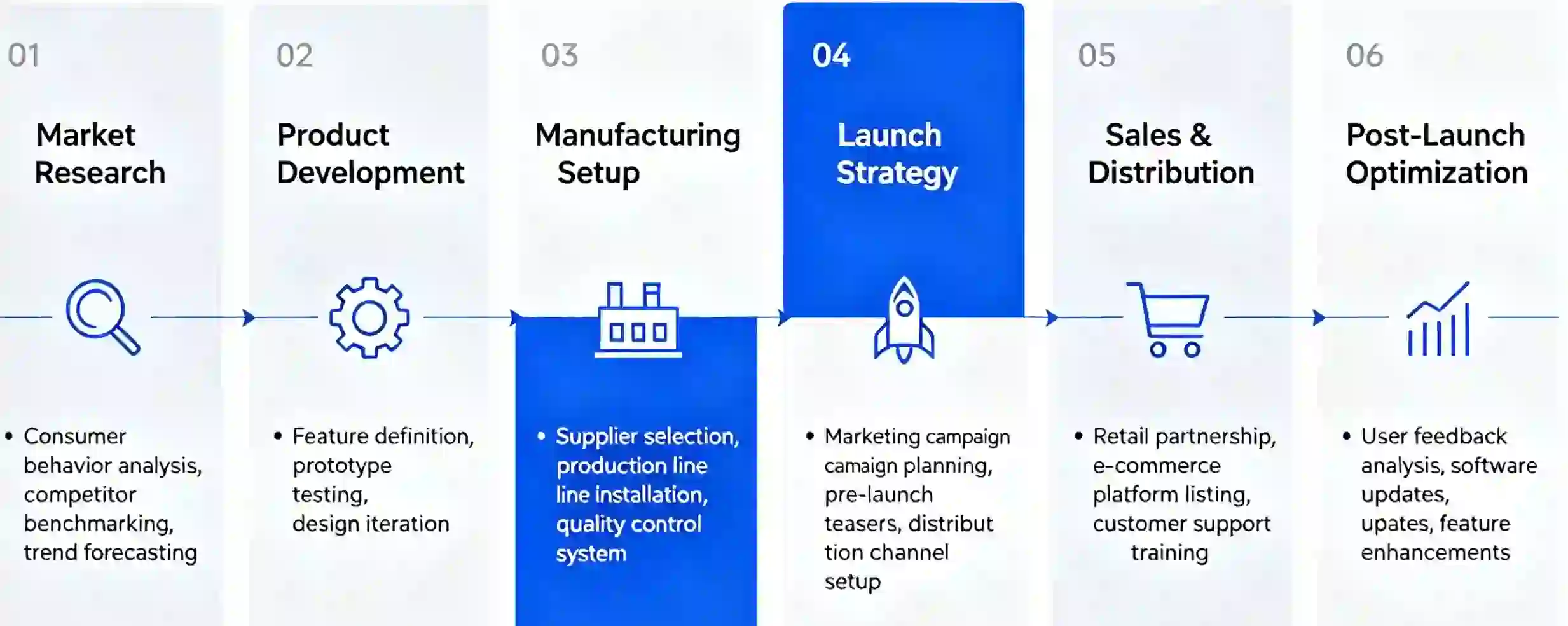
For global hardware product developers and D2C hardware brand founders, successful overseas hardware development is not a technical competition, but a comprehensive operation system covering market fit, product definition, supply chain mass production, channel scaling, global compliance, and cash flow control. To improve your hardware development success rate, you must avoid four fatal startup mistakes: eliminate invalid R&D via market-driven product positioning, avoid mass production failures with stable supply chain management, break sales bottlenecks through multi-channel global marketing, and prevent operational risks with standardized compliance and financial systems.
Overseas hardware startups do not need a perfect first-version product. Instead, they need accurate global market insight, reliable mass production delivery capabilities, scalable cross-border sales models, and strict risk management. By adopting this full-link hardware development and overseas operation strategy, new hardware brands can minimize trial-and-error costs, avoid common startup failures, and achieve steady growth from prototype testing to best-selling global hardware products.