 XIAODING-TECH

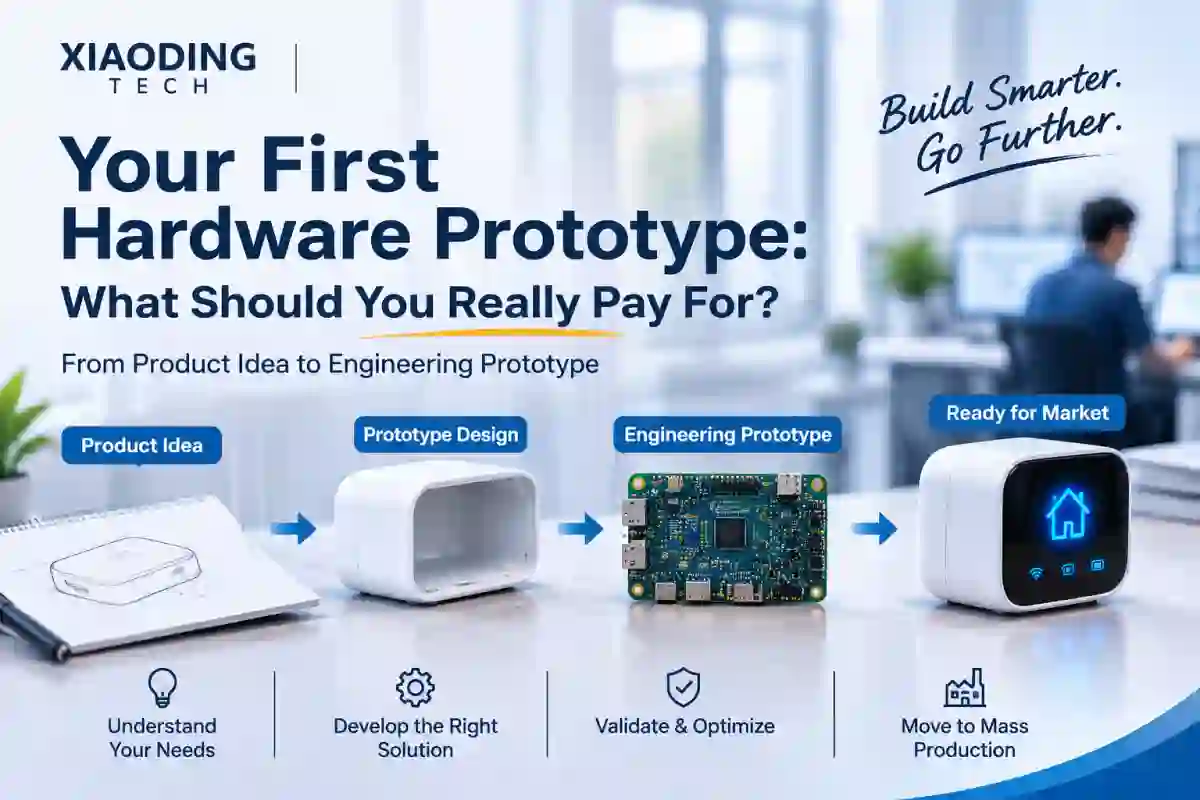
A Practical Cost Guide for Hardware Startups, Product Founders, and Global Brands
Developing your first electronic hardware product is an exciting journey. You have an idea, a target market, and perhaps even a preliminary product design. Now, you want to turn that idea into a working prototype.
But when you start contacting hardware development companies, you may discover something unexpected: prototype development quotations can vary dramatically.
One supplier quotes $800. Another quotes $2,500. A professional engineering team may quote $5,000–$7,000 or even more.
Why is there such a big difference?
Are you paying too much, or are you comparing completely different development services?
The answer is often the latter.
A hardware prototype is not a standardized product. Its cost depends on the engineering work, customization level, technical complexity, testing requirements, and deliverables involved.
Before choosing a supplier based on price, it is important to understand what you are actually paying for.
This guide explains the different types of hardware prototypes, what affects development costs, what you should expect from an engineering partner, and how to plan your budget from the first prototype to mass production.
1. What Does a Hardware Prototype Actually Mean?
The word “prototype” is widely used in the hardware industry, but it can mean very different things.
For one company, a prototype may simply be a 3D-printed enclosure with existing electronic components.
For another, it may involve custom PCB development, firmware programming, الهندسة الميكانيكية, product integration, and multiple rounds of testing.
Both may be called prototypes, but they represent very different levels of engineering work.
Generally, hardware prototypes can be divided into three categories.
1.1 Appearance Prototype (Mockup)
An appearance prototype is primarily used to demonstrate the product’s physical appearance, dimensions, shape, and user experience.
Typical work includes:
- 3D modeling and enclosure design.
- 3D printing or CNC machining.
- Basic mechanical assembly.
- Appearance and dimensional adjustments.
- Initial ergonomic evaluation.
What can it verify?
- Does the product look as expected?
- Are the dimensions and proportions appropriate?
- Does the product feel comfortable to hold or operate?
- Is the general appearance suitable for the target market?
What can it NOT fully verify?
- Whether all electronic functions work.
- Whether the internal structure is reliable.
- Whether the product meets regulatory requirements.
- Whether the design is ready for mass production.
An appearance prototype is suitable for early concept validation, product presentations, and initial design reviews.
1.2 Functional Prototype
A functional prototype focuses on whether the product’s core functions can actually work.
It may involve custom electronics, existing development boards, sensors, البرامج الثابتة, and mechanical integration.
Typical work includes:
- Electronic circuit development.
- PCB design and fabrication.
- Component selection.
- Firmware development.
- Functional integration.
- Basic performance testing.
What can it verify?
- Can the main functions be implemented?
- Do the electronic components work together?
- Does the firmware perform the expected operations?
- Can the product demonstrate its intended features?
لكن, a functional prototype does not automatically mean the product is ready for manufacturing.
Its enclosure, thermal performance, reliability, electrical safety, and manufacturability may still require further engineering work.
1.3 Engineering Prototype
An engineering prototype goes beyond simply demonstrating that a product works.
Its purpose is to evaluate whether the product design can support further engineering development, manufacturing preparation, and eventual commercialization.
Depending on the project scope, it may include:
- التصميم الصناعي (ID).
- Mechanical design (MD).
- Electronic hardware development.
- Firmware development.
- Mechanical and electronic integration.
- Prototype assembly.
- Design verification and optimization.
- Engineering documentation.
- Preliminary DFM (Design for Manufacturing) review.
What can it help verify?
- Does the integrated product meet its defined functional requirements?
- Are the mechanical and electronic systems compatible?
- Are there major engineering issues that need to be resolved?
- Can the design move toward tooling and manufacturing preparation?
- What additional testing or certification work may be required?
An engineering prototype is not automatically a certified or production-ready product. Additional validation, tooling trials, compliance testing, and pilot production may still be necessary.
The appropriate prototype level depends on your product development objectives.
2. Why Do Hardware Prototype Development Costs Vary So Much?
The biggest mistake when comparing quotations is assuming that every supplier is offering the same service.
In reality, several factors determine the final development cost.
2.1 Product Complexity
A simple electronic accessory and a smart IoT device may both be called consumer electronics, but their engineering requirements are very different.
Consider the following examples:
| Product Type | Potential Engineering Requirements |
|---|---|
| Basic electronic accessory | Simple PCB, power management, basic enclosure |
| Bluetooth speaker | Audio circuit, Bluetooth integration, acoustic tuning, battery management |
| Smart home device | Wireless connectivity, sensors, البرامج الثابتة, mobile application integration |
| AI-enabled hardware | Processing platform, sensors, connectivity, software integration |
| Medical-related electronics | Specialized design controls, risk management, and applicable compliance requirements |
The more complex the product, the more engineering coordination, integration, and testing it may require.
2.2 Customization Level
Are you using existing components and development boards, or do you need a completely customized solution?
For example:
- Using an existing electronic module may reduce initial development work.
- Designing a custom PCB requires additional engineering.
- Developing proprietary firmware adds programming and debugging work.
- Creating a customized mechanical structure requires 3D modeling, structural design, and verification.
A highly customized product naturally requires more engineering resources than a product assembled from existing solutions.
2.3 Industrial and Mechanical Design
The physical appearance of a product is only one part of its mechanical design.
A well-developed product may also require:
- Internal component layout.
- Structural strength evaluation.
- Assembly considerations.
- Material selection.
- Heat dissipation analysis.
- Waterproofing or dust protection design, when required.
- Moldability and manufacturing considerations.
A beautiful external design does not necessarily mean the internal engineering is complete.
2.4 Firmware and System Integration
Electronic hardware needs to communicate with software and other components.
Depending on the product, firmware development may involve:
- Microcontroller programming.
- Sensor data processing.
- Wireless communication.
- Power management.
- User interface control.
- System debugging.
- Performance optimization.
The development workload depends on the number of functions and the complexity of their interactions.
2.5 Testing and Design Iterations
The first prototype is rarely perfect.
During development, engineers may identify:
- Mechanical interference.
- Unstable electronic performance.
- Firmware errors.
- Battery or power consumption issues.
- Temperature problems.
- Unexpected performance limitations.
Some issues require component replacement, PCB revisions, structural modifications, or additional prototype builds.
This is why the number of prototype iterations and the scope of testing should be clearly defined before development begins.
3. What Are You Actually Paying For?
When you receive a hardware development quotation, do not look only at the final number.
Look at the engineering work and deliverables behind it.
A customized hardware development project may involve several professional disciplines.
| Development Area | Main Responsibilities |
|---|---|
| Product Definition | Requirements analysis and technical planning |
| التصميم الصناعي | Product appearance and user experience |
| Mechanical Design | Internal structure and enclosure engineering |
| Electronics Development | Circuit design and PCB development |
| Firmware Development | Embedded software and functional control |
| Prototype Manufacturing | Parts fabrication and assembly |
| Testing & Optimization | Functional verification and engineering improvements |
Not every project requires all these services.
For example, a client who already has completed industrial and mechanical designs may only need electronic development and prototype integration.
Another client may need support from the initial product concept through a complete engineering prototype.
A professional quotation should reflect the actual engineering scope, not simply the number of physical samples being delivered.
Engineering Deliverables Matter
Before accepting a quotation, clarify what you will receive.
Depending on the agreed development scope, deliverables may include:
- 3D mechanical design files.
- PCB design files.
- Electronic schematics.
- Bill of Materials (BOM).
- Firmware source code or agreed software deliverables.
- Prototype samples.
- Functional testing records.
- Engineering documentation.
- Preliminary DFM recommendations.
Not all deliverables are automatically included in every project. Source files, software ownership, intellectual property rights, and documentation handover should be explicitly agreed upon in the development contract.
These engineering assets can be important for future product modifications, supplier transitions, الأدوات, and manufacturing.
4. Is a $5,000–$10,000 Hardware Prototype Budget Expensive?
There is no universal answer.
A $5,000 quotation may be expensive for a simple appearance model but reasonable for a customized electronic product requiring mechanical, electronic, and firmware engineering.
The correct question is not:
“How much does one prototype cost?”
It is:
“What engineering work is required to achieve my development objectives?”
For selected projects with moderate technical complexity, a development budget of approximately $5,000–$10,000 may be a reasonable initial reference for customized prototype development.
لكن, this is not a fixed industry price or a guaranteed package. Actual costs depend on the product requirements, design maturity, technical complexity, number of iterations, and agreed deliverables.
When Might This Budget Be Appropriate?
You may need this level of development investment if:
- You are developing an original electronic hardware product.
- You need customized electronics rather than simple off-the-shelf components.
- Your project requires mechanical and electronic integration.
- Firmware development is necessary.
- You need a working prototype for technical evaluation.
- You intend to continue toward tooling and mass production.
When Might It Be More Than You Need?
A full engineering development service may not be necessary if:
- You only need an existing product sample.
- You want to evaluate an appearance concept.
- You only need a simple 3D-printed model.
- You can use an existing development board without customization.
- Your product requirements are still too unclear to begin engineering work.
In these situations, a smaller and more focused development task may be a better starting point.
The goal is not to spend more money. The goal is to invest in the right engineering work at the right development stage.
5. Why Choosing the Cheapest Prototype Quote Can Be Risky
Choosing a supplier based only on the lowest initial quotation can create problems later.
This does not mean that a low-cost supplier necessarily provides poor quality. It means that you should understand exactly what is included in the proposed service.
Consider a few common situations.
Situation 1: The Prototype Works, but the Design Cannot Be Continued
A prototype may demonstrate its basic functions using existing modules and temporary wiring.
لكن, the design may still require a custom PCB, optimized internal layout, and proper mechanical integration before manufacturing.
The initial prototype cost may be low, but additional engineering work will be necessary.
Situation 2: The Product Looks Good, but the Internal Structure Is Not Ready
A product can look attractive from the outside while having unresolved internal design problems.
For example:
- Components may interfere with each other.
- Battery installation may be difficult.
- Heat dissipation may be insufficient.
- Assembly may require too many manual operations.
- The enclosure may not be suitable for injection molding.
These issues should ideally be identified and addressed before committing to expensive tooling.
Situation 3: You Do Not Receive the Engineering Files
If the supplier does not provide the agreed design files, documentation, or software handover, future development may become difficult.
You may need to repeat certain engineering tasks or depend entirely on the original supplier.
Before starting a project, clarify:
- Which design files will be delivered?
- Who owns the developed intellectual property?
- Can another engineering team continue the project?
- Are there third-party components or software licenses involved?
Situation 4: Testing and Validation Were Not Included
A working prototype does not automatically prove product reliability or regulatory compliance.
Depending on the product and target market, further work may include:
- Electrical safety evaluation.
- EMC testing.
- Wireless certification.
- Battery safety testing.
- Environmental testing.
- Product-specific regulatory assessments.
The required tests should be identified according to the product category and destination market.
A low initial quotation is not necessarily a low total development cost. Compare the complete scope, not just the first payment.
6. How Much Should You Budget From Prototype to Mass Production?
Prototype development is only one stage of bringing an electronic hardware product to market.
A realistic project budget should consider the entire development journey.
منصة 1: Product Definition and Evaluation
Before development begins, the project needs a clear understanding of:
- Product functions.
- Target users.
- Technical requirements.
- Market positioning.
- Key components and technologies.
- Development feasibility.
The purpose is to establish a realistic development scope before committing significant engineering resources.
منصة 2: Engineering Development and Prototype
This stage may include industrial design, الهندسة الميكانيكية, إلكترونيات, البرامج الثابتة, prototype fabrication, and functional validation.
The exact scope depends on the product.
منصة 3: Mold and Tooling Development
If the product requires injection-molded plastic or customized tooling, mold development may become a significant investment.
The cost depends on:
- Product size and structure.
- Number of components.
- Mold complexity.
- Material selection.
- Surface finish requirements.
- Expected production volume.
Tooling should generally begin after the relevant product structure and design have been sufficiently reviewed and confirmed.
منصة 4: Pilot Production and Validation
Before mass production, a pilot run can help identify manufacturing and assembly problems.
This stage may involve:
- Assembly process verification.
- Functional testing.
- Quality inspection.
- Yield evaluation.
- Design corrections.
منصة 5: إنتاج متسلسل
The final production budget depends on order quantity, component costs, manufacturing processes, التعبئة والتغليف, quality requirements, والخدمات اللوجستية.
An Important Budgeting Principle
Do not spend your entire available budget on the first prototype.
Keep sufficient financial resources for engineering revisions, الأدوات, اختبار, شهادة, and initial production.
A successful hardware project requires financial planning beyond the first working sample.
7. Nine Questions to Ask Before Accepting a Prototype Quotation
Before selecting a hardware development company, ask these questions.
- What exactly is included in the quotation?
Does it cover appearance design, الهندسة الميكانيكية, إلكترونيات, البرامج الثابتة, assembly, and testing? - Is the PCB customized or based on an existing development board?
Understand the level of customization. - How many prototype iterations are included?
Clarify the number of revision rounds and what counts as additional work. - What are the expected deliverables?
Request a clear list of engineering files, documentation, and physical samples. - Who owns the intellectual property?
Clarify ownership of custom designs, البرامج الثابتة, and related engineering assets. - What testing will be performed?
Distinguish basic functional verification from formal laboratory testing and certification. - What happens if the prototype does not meet the agreed requirements?
Understand the correction process and responsibilities of both parties. - Can the supplier support tooling and mass production?
Ask about the next development stages and manufacturing capabilities. - What is the estimated total project investment?
Request an initial roadmap covering development, الأدوات, اختبار, and production.
A professional development partner should be able to explain the scope, process, responsibilities, and expected outcomes clearly.
8. How XIAODING TECH Supports Your Hardware Development Journey
XIAODING TECH is a Shenzhen-based electronic hardware ODM development company serving global product founders, startups, and brands.
We help turn product concepts into engineered hardware products through integrated development and manufacturing support.
Our services can cover:
- Product concept evaluation.
- التصميم الصناعي (ID).
- Mechanical design (MD).
- Electronic hardware development.
- PCB and PCBA development.
- Embedded firmware development.
- Prototype fabrication and integration.
- Engineering verification.
- Supply chain integration.
- Tooling coordination and mass production support.
With experience across more than 500 product cases, XIAODING TECH brings engineering experience and Shenzhen’s electronics manufacturing ecosystem together to support customized hardware development projects.
Our approach is based on one important principle:
We do not simply aim to build a prototype. We aim to help develop a product with a practical engineering foundation for future manufacturing.
What Kind of Projects Are We Looking For?
We are particularly interested in working with:
- Global hardware startups with defined product concepts.
- Product founders developing original electronic devices.
- Established brands launching new hardware products.
- Companies seeking customized ODM development.
- Businesses planning to move from prototype validation toward mass production.
We value projects with clear requirements, realistic budgets, and a genuine commitment to product development.
We believe the best results come from long-term engineering collaboration rather than one-time sample transactions.
Is XIAODING TECH the Right Partner for Your Project?
We may not be the best fit if you only need:
- A ready-made product sample.
- A simple product relabeling service.
- The cheapest possible prototype.
- A free, detailed engineering solution without a defined development commitment.
لكن, if you are serious about developing your own electronic hardware product and need an engineering partner who can support the journey from concept to manufacturing, we would be happy to understand your project.
9. Ready to Turn Your Product Idea Into Reality?
Before requesting a quotation, prepare some basic information about your project.
You do not need a complete engineering specification at the beginning. لكن, the more clearly you can explain your product, the more accurately we can understand its development requirements.
Please share:
- Product Concept: What product do you want to develop?
- Main Functions: What should the product do?
- Target Market: Which countries or markets are you targeting?
- Current Development Stage: Idea, initial design, existing prototype, or completed design?
- Development Budget: What budget have you allocated for engineering development?
- Expected Timeline: When do you hope to complete the prototype or start production?
- Production Plan: Do you have an estimated future production quantity?
Our team can review the available information and determine whether the project is suitable for our development capabilities.
Let’s Build Something Real.
شياو دينج تك
Your Hardware Product Development Partner in Shenzhen, الصين.
From Product Concept to Engineering Development, Prototype Validation, and Mass Production.
Website: https://www.xiaodingtech.cn/
اتصال: شياو دينغ
واتساب: +86-15013883553
بريد إلكتروني: contact@xiaodingtech.cn
Submit Your Hardware Project Inquiry
Let’s start with a clear understanding of your product, your goals, and the engineering work required to bring it to life.
الأسئلة المتداولة (FAQ)
1. How much does it cost to develop a hardware prototype?
The cost depends on the product’s complexity, customization requirements, engineering scope, and testing needs. A simple appearance model may require much less investment than a customized electronic engineering prototype. For selected projects, $5,000–$7,000 can be an initial reference for customized prototype development, but a project-specific quotation is necessary.
2. Why do hardware prototype quotations vary so much?
Different suppliers may offer different development scopes. Some provide 3D printing and basic assembly, while others provide customized PCB design, firmware development, الهندسة الميكانيكية, integration, and testing. Always compare deliverables and responsibilities, not just prices.
3. Does a functional prototype mean my product is ready for mass production?
No. A functional prototype demonstrates that certain product functions work. Additional engineering validation, design optimization, الأدوات, compliance testing, and pilot production may still be required.
4. How long does hardware prototype development take?
The timeline depends on technical complexity, design readiness, component availability, and the number of development iterations. A preliminary schedule should be established after the project requirements have been reviewed.
5. Can I use my own design and only ask a company to build the prototype?
نعم. If you already have mechanical drawings, PCB files, BOM information, or firmware, a development company may be able to provide prototype fabrication, assembly, integration, or engineering support. The required scope should be reviewed before quotation.
6. Should I develop a prototype before making an injection mold?
For most customized products requiring new plastic enclosures, it is advisable to validate the important mechanical and functional aspects before committing to production tooling. The appropriate validation level depends on the product and its manufacturing risks.
7. Can XIAODING TECH support my project from prototype to mass production?
XIAODING TECH provides integrated electronic hardware ODM development and manufacturing support in Shenzhen, الصين. The specific services available for each project depend on its technical requirements, development scope, and production plan.
Final Thought
The right hardware prototype is not necessarily the cheapest one.
It is the prototype that helps you answer the most important engineering questions, reduce development uncertainty, and move your product toward its next stage with a clear plan.
Before asking, “How much does one prototype cost?”, ask yourself:
“What do I need this prototype to prove, and what do I need to achieve after it?”
That is where a successful hardware development project begins.
Other Related Links:
Development Guide for Electronic Hardware Product Projects:
https://www.xiaodingtech.cn/dev-insights-workflow/hardware-product-development-guide/
Free Assessment for Electronic Hardware Product Projects:
https://www.xiaodingtech.cn/free-evaluation-for-consumer-electronics-innovation-projects/