 XIAODING-TECH

Category: Hardware Product Development Guide
Reading time: Approximately 10–12 minutes
You have an idea for a new electronic product. Perhaps you want to develop a smart home device, a personal care product, a connected IoT product, or a new consumer electronics device.
You know what you want the product to do, but you may not know how to turn that idea into a working prototype, how much development will cost, or what it takes to prepare the product for mass production.
This is a common challenge for hardware founders, startups, product managers, and established brands.
Unlike software products, electronic hardware requires physical components, الهندسة الإلكترونية, mechanical design, prototypes, اختبار, manufacturing planning, and supply chain coordination. Decisions made early in development can significantly affect product cost, reliability, development time, and manufacturing feasibility.
The good news is that hardware development becomes more manageable when it is divided into clear stages, each with defined objectives and deliverables.
In this guide, we explain how to turn a product idea into an electronic hardware product, from initial concept and market validation to engineering development, النماذج الأولية, اختبار, and mass production.
Quick Answer: How Do You Turn a Product Idea into a Hardware Product?
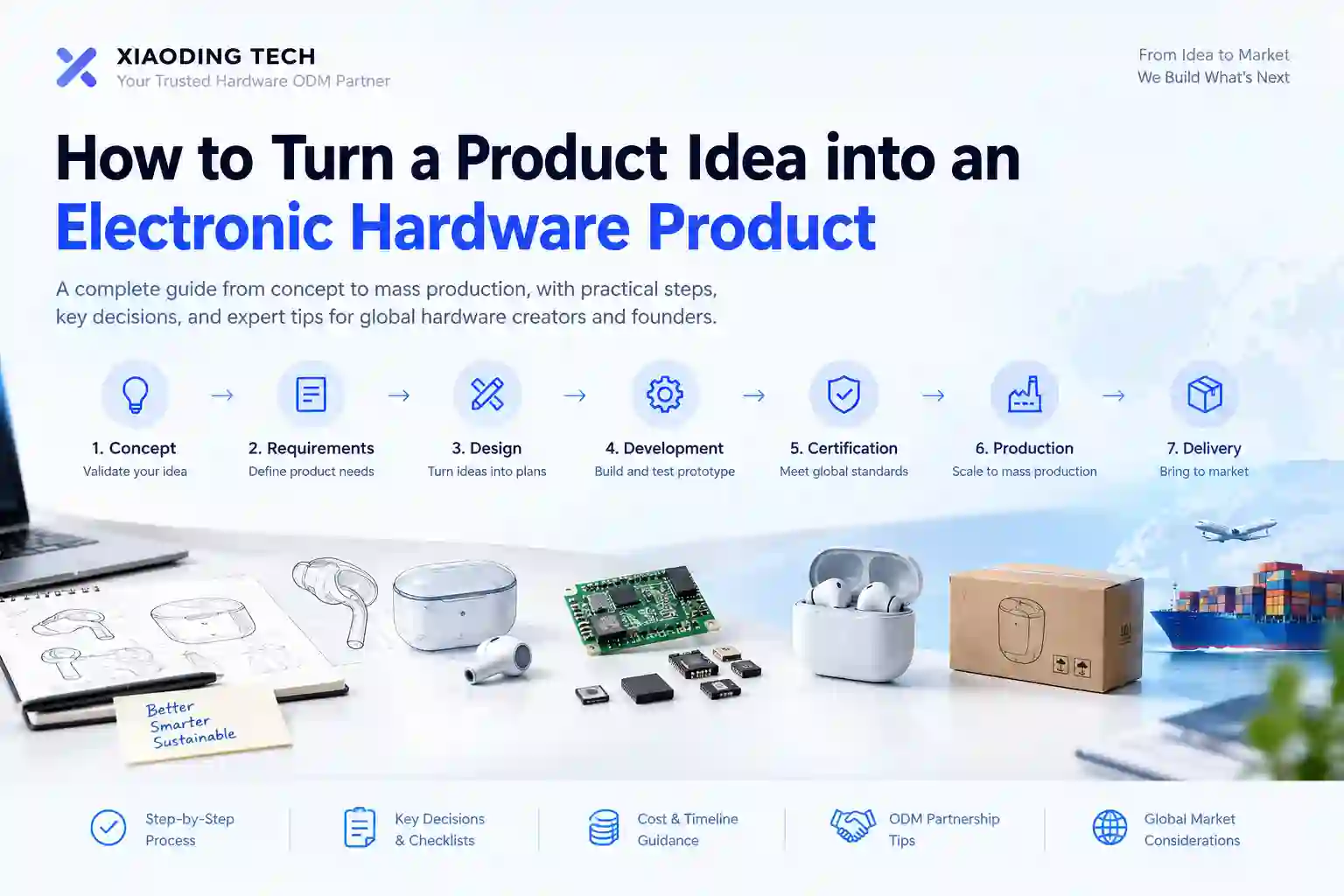
To turn a product idea into an electronic hardware product, follow these eight steps:
- Define the problem your product solves and identify its target users.
- Validate market demand before committing to full development.
- Write a product requirements document (PRD).
- Evaluate technical feasibility, target cost, and development risks.
- Select the hardware architecture and develop the initial design.
- Build and evaluate a functional prototype.
- Validate the design through engineering testing and design verification.
- Prepare the product, suppliers, manufacturing processes, and quality controls for mass production.
The exact process depends on product complexity, regulatory requirements, available technology, and business objectives.
A relatively simple electronic accessory may need a different development process from a battery-powered IoT device, a wireless product, or a product containing motors, heating elements, or medical-related functions.
The most important principle is to validate the right things at each stage before investing heavily in the next one. A working prototype is an important milestone, but it does not automatically mean that a product is safe, موثوق, cost-effective, or ready for mass production.
Step 1: Define the Problem Before Designing the Product
One of the most common mistakes in hardware development is starting with features instead of a clearly defined customer problem.
For example, a founder may want to develop a smart water bottle with temperature sensing, Bluetooth connectivity, a mobile app, and a rechargeable battery.
لكن, the first question should not be which Bluetooth module to use. It should be whether the intended customers actually need these features and whether they would pay for the resulting product.
Start by answering five questions:
- Who will use the product?
- What problem does it solve?
- How do people solve this problem today?
- Why would customers choose your product over existing alternatives?
- What is the minimum set of features required to deliver the core benefit?
A useful product concept statement is:
“Our product helps [target user] solve [specific problem] by providing [main benefit] under [key usage conditions].”
For example:
“Our portable environmental monitor helps warehouse operators identify temperature and humidity conditions that may damage stored products by providing continuous measurement and clear visual alerts.”
This statement is more useful for engineering than a broad description such as “a smart environmental monitoring device.”
It identifies the user, the application, the primary function, and an important design requirement.
What to do at this stage
Create a one-page product concept document containing:
- Target customer and application.
- Main customer problem.
- Proposed solution.
- Essential product features.
- Expected selling price or target market segment.
- Initial assumptions about size, power, connectivity, and environment.
- Main questions that still need validation.
Deliverable: A clear product concept that can be evaluated commercially and technically.
Step 2: Validate Market Demand Before Full Development
A technically feasible product is not necessarily a commercially viable product.
Before investing in custom electronics, الأدوات, or a large engineering team, gather evidence that customers have a real need for the proposed solution.
Market validation does not require an expensive research project. It can begin with structured conversations and low-cost experiments.
Practical ways to validate demand
1. Interview potential customers
Talk to people who match your intended customer profile. Ask how they currently solve the problem, what frustrates them, what alternatives they have tried, and what constraints affect their purchasing decisions.
Avoid relying only on questions such as “Would you buy this product?” Actual purchasing behavior, budget discussions, and existing spending often provide stronger evidence than hypothetical enthusiasm.
2. Research competing products
Review existing products, their specifications, pricing, customer reviews, positioning, and limitations.
Look for unmet needs rather than assuming that adding more features will create a competitive advantage.
3. Test the concept before building the complete product
Depending on the product, you might use renderings, a mock-up, a landing page, a demonstration model, or a limited pilot to test customer interest.
4. Establish commercial assumptions
Estimate the likely selling price, target customer segment, expected sales channel, and acceptable product cost.
These figures are preliminary assumptions, not confirmed financial results.
When should you move forward?
Proceed when you have enough evidence to explain:
- Who is likely to buy the product.
- Why the product is needed.
- What differentiates it from alternatives.
- What customers may be willing to pay.
- What must be true for the business to be viable.
You do not need perfect certainty before starting development. You do need to identify the biggest commercial uncertainties and decide how to test them.
Deliverable: A market validation summary with key findings, assumptions, and unresolved risks.
Step 3: Write a Product Requirements Document (PRD)
Once the concept is sufficiently clear, translate it into requirements that product designers, electronic engineers, mechanical engineers, software developers, and manufacturing partners can understand.
A product requirements document (PRD) acts as a shared reference for what the product must do and how success will be evaluated.
Without clear requirements, different team members may make conflicting assumptions. The result can be repeated revisions, additional costs, and disagreements about whether the product is finished.
What should a hardware PRD include?
| Requirement area | Questions to answer |
|---|---|
| Core functions | What must the product do? |
| Performance | What measurable performance targets must it achieve? |
| User experience | How will users operate and interact with it? |
| Physical design | What are the target dimensions, weight, materials, and mounting requirements? |
| Power | Does it use a battery, USB power, an adapter, or another source? |
| Connectivity | Does it require Bluetooth, Wi-Fi, cellular, USB, or no connectivity? |
| Operating environment | What temperatures, humidity levels, vibration, dust, or water exposure are expected? |
| Safety and compliance | Which safety, radio, battery, or market-specific requirements may apply? |
| تصنيع | What are the target cost, production quantity, and assembly constraints? |
| Verification | How will each important requirement be tested and accepted? |
Requirements should be measurable wherever possible.
For example, “the battery should last a long time” is not a testable requirement.
A more useful requirement might be:
“The device shall operate for at least 10 hours under the defined normal-use test conditions.”
The target must be validated against actual power consumption, battery capacity, operating conditions, and safety requirements. It should not be treated as an achievable specification until engineering analysis and testing support it.
Similarly, “the product should be waterproof” is incomplete. The required ingress protection level, exposure conditions, test method, and acceptance criteria must be defined where applicable.
Separate must-have features from optional features
For the first product version, classify requirements into three groups:
- Must-have: Essential to solve the core customer problem.
- Should-have: Important, but potentially deferrable.
- Nice-to-have: Useful enhancements that can be considered in later versions.
This prevents unnecessary complexity from entering the first development cycle.
Deliverable: An agreed PRD with measurable requirements, priorities, and acceptance criteria.
For a more detailed guide, see: How to Write a Hardware Product Requirements Document (PRD).
Step 4: Evaluate Technical Feasibility, يكلف, and Risk
Before committing to a complete design, evaluate whether the proposed product can be built within the intended budget, schedule, size, performance, and manufacturing constraints.
This stage is especially important when the product includes custom electronics, wireless connectivity, rechargeable batteries, heating elements, motors, sensors, or demanding mechanical requirements.
Evaluate technical feasibility
The engineering team should identify the main technical subsystems and determine how they might work together.
Depending on the product, these may include:
- Electronic control and processing.
- Sensors and signal conditioning.
- Power management and battery charging.
- Wireless or wired communication.
- Embedded firmware.
- Mobile applications or cloud services.
- Mechanical enclosure and assembly.
- Thermal management and safety protection.
Not every product needs all these subsystems. The goal is to identify the components that are actually necessary for the intended application.
Estimate the total development and launch budget
A hardware project budget may include:
| Cost category | Typical scope |
|---|---|
| Product design | التصميم الصناعي, الهندسة الميكانيكية, and design iteration |
| إلكترونيات | Circuit design, PCB layout, and component selection |
| Firmware and software | Embedded software, applications, and connectivity where needed |
| Prototypes | Components, fabrication, assembly, and rework |
| Testing | Functional, reliability, safety, and compliance testing as applicable |
| الأدوات | Injection molds, fixtures, and other production tooling where required |
| Manufacturing preparation | Test fixtures, production documentation, and process development |
| Initial production | Components, assembly, التعبئة والتغليف, and quality inspection |
| Launch and logistics | Applicable certification costs, shipping, duties, and other launch expenses |
These categories should be estimated separately. A supplier quote covering engineering development may not include tooling, third-party laboratory testing, production inventory, or international shipping.
Identify the biggest risks early
A useful early-stage risk assessment includes:
- Technical feasibility and performance.
- Component availability and lifecycle.
- Battery and electrical safety.
- Mechanical durability and thermal behavior.
- Software and connectivity reliability.
- Regulatory requirements in target markets.
- Manufacturing yield and quality consistency.
- Development schedule and budget uncertainty.
For each significant risk, record its potential impact, likelihood, validation method, owner, and target completion date.
Do not wait until the prototype is complete to investigate a risk that could invalidate the entire design.
Deliverable: A preliminary technical architecture, budget range, schedule assumptions, and prioritized risk register.
Step 5: Select the Hardware Architecture and Develop the Initial Design
Once the main requirements and risks are understood, the engineering team can develop the product architecture.
The architecture defines how the product’s electronic, ميكانيكية, برمجة, and power subsystems work together.
Decide what should be custom and what can be reused
Not every electronic product requires a completely custom circuit board or every component to be designed from scratch.
Depending on the requirements, a project may use:
- Existing electronic modules or development boards.
- Standard communication modules.
- Off-the-shelf sensors and power components.
- A custom PCB for the product’s specific requirements.
- Existing mechanical components or customized enclosures.
- Custom firmware and application software.
Using existing components can reduce initial development effort, but it does not eliminate integration, verification, lifecycle, شهادة, or manufacturing requirements.
A development board may be useful for an early proof of concept but unsuitable for the final commercial product because of its size, cost, power consumption, connector arrangement, or production constraints.
Consider the whole product, not just the PCB
A product may function correctly on the workbench and still fail when installed inside its enclosure.
لهذا السبب, electronic and mechanical design should be coordinated.
The design team may need to consider:
- PCB dimensions and mounting points.
- Antenna placement and radio performance.
- Heat dissipation.
- Battery placement and protection.
- Cable routing and connector access.
- Waterproofing or dust protection.
- Assembly sequence and serviceability.
- Component tolerances and enclosure fit.
Design decisions should reflect both product performance and the realities of manufacturing.
Deliverable: A preliminary system architecture and a coordinated design plan for the electronic, ميكانيكية, البرامج الثابتة, and other required subsystems.
Step 6: Build a Functional Prototype
A prototype is a physical or functional representation of a product used to answer specific questions before further investment.
It is important to define what a prototype is intended to prove. A model that demonstrates the user interface may not validate electronic performance, while a working electronic assembly may not demonstrate manufacturability or production-level reliability.
Common types of hardware prototypes
Concept prototype
Used to communicate the idea, explore size and shape, or test the intended user experience. It may not contain fully functional electronics.
Functional prototype
Used to demonstrate core functions and evaluate whether the proposed technical approach works.
Engineering prototype
Used to investigate system integration, performance, mechanical fit, thermal behavior, and other engineering requirements.
Production-intent prototype
Built with a design and manufacturing approach that more closely represents the intended production product. It supports more meaningful design verification and manufacturing preparation.
These categories are practical descriptions, not universal formal stages. Their names and scope may vary between companies and projects.
What should you test on the first functional prototype?
Focus on the questions that matter most:
- Does the core function work?
- Does the product achieve its most important performance targets?
- Are the selected components suitable?
- Does the power system behave as expected?
- Can the electronics, البرامج الثابتة, and mechanical parts work together?
- What fails under normal and foreseeable operating conditions?
- Which assumptions need to be changed before the next build?
Record test results and known limitations rather than relying on informal demonstrations.
Deliverable: A functional prototype, test results, a list of engineering issues, and a prioritized plan for the next development iteration.
Step 7: Test, Refine, and Validate the Design
A successful demonstration is not the same as a validated product.
Engineering validation should establish whether the product meets the agreed requirements under defined test conditions.
The exact testing program depends on product type, operating environment, risk level, and intended sales markets.
Typical areas of hardware testing
| Test area | What it helps establish |
|---|---|
| Functional testing | Whether required functions operate correctly |
| Performance testing | Whether measurable targets are achieved |
| Power testing | Actual power consumption, battery life, and charging behavior where applicable |
| Thermal testing | Whether temperatures remain within specified limits |
| Mechanical testing | Whether the enclosure, connectors, and moving parts withstand relevant loads |
| Environmental testing | Whether the product performs under specified temperature, humidity, vibration, or other conditions |
| Reliability testing | Whether the product maintains performance over defined use cycles or stress conditions |
| Connectivity testing | Whether communication performs as required in the intended environment |
| Compliance testing | Whether applicable regulatory and safety requirements are met |
Not every product requires every test. The test plan should be based on documented requirements, foreseeable failure modes, risk assessment, and the intended market.
Use staged validation
A common hardware development framework is EVT, تجلط الأوردة العميقة, and PVT:
- EVT — Engineering Validation Test: Evaluate whether the engineering design and main technical approach meet the critical requirements.
- DVT — Design Validation Test: Verify that the more mature design meets its intended performance, user, environmental, and applicable compliance requirements.
- PVT — Production Validation Test: Evaluate whether the production process can consistently manufacture the product to the required specifications.
These phases have different purposes and should not be treated as interchangeable labels. Entry criteria, test scope, sample sizes, and exit criteria should be defined for each project.
Before moving to the next stage, review unresolved issues, test evidence, and the risk of proceeding.
Deliverable: A documented validation status, test reports, corrective actions, and a decision on whether the design is ready for the next phase.
Step 8: Prepare for Manufacturing and Mass Production
A product that works in a prototype build may still be expensive, difficult, or inconsistent to manufacture at scale.
Manufacturing preparation should begin during design, not after all engineering work is complete.
Design for Manufacturing (سوق دبي المالي)
Design for Manufacturing, or DFM, means considering manufacturing constraints while developing the product.
A DFM review may examine:
- Component availability and alternative parts.
- PCB fabrication and assembly constraints.
- Mechanical tolerances and enclosure design.
- Assembly time and process complexity.
- Fasteners, adhesives, cables, and connectors.
- Test access and production test coverage.
- Material selection and cosmetic quality.
- Packaging and transport protection.
A product with fewer unnecessary parts, a simpler assembly sequence, and clear test requirements may be easier to manufacture consistently.
لكن, design simplification must not compromise essential safety, reliability, or performance requirements.
Prepare the production process
Before mass production, the project team should establish the appropriate production documentation and controls, which may include:
- Approved BOM and component specifications.
- Released PCB, ميكانيكية, and firmware revisions.
- Assembly instructions and work instructions.
- Production test procedures and fixtures.
- Incoming inspection and in-process quality checks.
- Final inspection and acceptance criteria.
- Traceability and nonconformance handling.
- Packaging specifications and shipment requirements.
The required documentation depends on the product and manufacturing arrangement.
Plan the first production run carefully
The first production run should be based on evidence of product readiness, manufacturing capability, customer demand, and available cash flow.
A large initial order may reduce the unit price in some circumstances, but it also increases inventory exposure and the cost of correcting problems if the design or market assumptions prove wrong.
A controlled initial run may be appropriate when demand is uncertain or when production processes still need to be proven.
Deliverable: A production-ready design package, an agreed quality plan, production test arrangements, supplier readiness, and a justified first-run quantity.
How Much Does It Cost to Turn a Product Idea into a Hardware Product?
There is no single reliable price for developing an electronic product. The cost depends on what the product must do, how much custom engineering it requires, the maturity of the starting design, and what is included in the development scope.
The following factors usually have a significant influence on the budget:
Product complexity. A simple electronic accessory is generally different from a connected product requiring custom electronics, البرامج الثابتة, a mobile application, and cloud services.
Design maturity. A project starting with a validated design and complete engineering documentation may need a different scope of work from a project starting with a broad concept.
Prototype iterations. More design iterations can increase component, fabrication, assembly, and engineering costs.
Tooling requirements. Custom injection molds or specialized production fixtures can create substantial upfront expenses.
Testing and compliance. Requirements depend on the product category, electrical design, wireless functions, battery configuration, and target markets.
Production volume. Component pricing, tooling allocation, manufacturing processes, and supplier terms can affect unit economics.
A useful budget separates one-time development costs from recurring product costs.
One-time costs may include engineering, prototypes, الأدوات, and certain laboratory tests. Recurring costs may include components, assembly, التعبئة والتغليف, inspection, اللوجستية, and applicable ongoing support.
When comparing quotes, confirm exactly which deliverables, revisions, tests, الأدوات, and production preparation activities are included.
For a deeper cost breakdown, see: How Much Does It Cost to Develop an Electronic Product?
How Long Does Hardware Product Development Take?
The development schedule depends on technical complexity, design maturity, prototype availability, component lead times, testing requirements, and the speed of project decisions.
A project schedule should account for more than engineering hours. It may also include:
- Requirements definition and design reviews.
- Component sourcing and procurement.
- PCB fabrication and assembly.
- Mechanical prototype production.
- Firmware and system integration.
- Test execution and corrective actions.
- Tooling and manufacturing preparation.
- Applicable compliance testing.
- Production planning and initial manufacturing.
Some activities can proceed in parallel, while others depend on previous decisions or test results.
For example, ordering tooling before the mechanical design is sufficiently mature may create expensive rework. Likewise, postponing compliance planning may reveal requirements too late in the schedule.
The most useful schedule identifies milestones, dependencies, responsible owners, review dates, and the conditions required to proceed to the next stage.
Avoid treating an early estimated timeline as a guaranteed delivery date. Update the schedule as technical risks are resolved and actual lead times become known.
Should You Develop the Product In-House or Work with an ODM Partner?
The right model depends on your team’s capabilities, available resources, desired control, and product requirements.
| Approach | Potential advantages | Important considerations |
|---|---|---|
| In-house development | Greater direct control over engineering priorities and internal knowledge | Requires suitable technical expertise, tools, management capacity, and supplier access |
| Independent design firms or engineering consultants | Access to specific skills without building a complete internal team | Responsibilities may be split across multiple parties |
| OEM manufacturer | Suitable when the customer provides the product design and needs manufacturing support, depending on the agreement | The customer may retain more responsibility for design maturity and engineering coordination |
| ODM development partner | Can combine product development and manufacturing-related capabilities, depending on the provider and contract | Scope, deliverables, design ownership, manufacturing responsibilities, and costs must be clarified |
These models are not mutually exclusive. A company may use an external engineering partner for electronics, retain industrial design in-house, and work with a manufacturer for production.
Before choosing a partner, assess technical capability, relevant project experience, communication practices, quality systems, manufacturing resources, and willingness to document the development process.
Do not evaluate a partner solely by its advertised capabilities or the lowest initial quotation.
How Can You Choose a Hardware Product Development Partner in China?
China may be a suitable development and manufacturing location for many electronic products, but the right partner depends on the specific product and project requirements.
For overseas companies, the evaluation should go beyond price and factory size.
Ask potential partners the following questions:
- Have they developed products with similar technical requirements?
- Which engineering activities are handled internally, and which are outsourced?
- What deliverables will be provided at each milestone?
- How are requirements, engineering changes, and project risks managed?
- How are prototype testing and design validation documented?
- What manufacturing and quality-control capabilities are available?
- How are component sourcing and alternative parts managed?
- How are intellectual property, design files, البرامج الثابتة, and tooling addressed in the contract?
- What costs are excluded from the quotation?
- How will communication, reporting, and project decisions work across time zones?
Request relevant evidence where appropriate, such as anonymized project examples, sample deliverables, testing documentation, or a clear explanation of the proposed development process.
A credible partner should be able to explain not only what it can do, but also what remains uncertain, what needs testing, and what assumptions support its estimate.
A Practical Checklist Before Starting Hardware Development
Before committing to a development project, use this checklist to identify missing information.
Product and market
- The target user and core problem are clearly defined.
- The main competitors and alternative solutions have been reviewed.
- There is evidence supporting the expected market demand.
- The target selling price and commercial assumptions are documented.
Requirements and engineering
- The core features and measurable requirements are documented.
- Must-have and optional features are separated.
- The initial technical architecture has been evaluated.
- Major technical, safety, and supply chain risks have been identified.
- The prototype’s purpose and acceptance criteria are defined.
Budget and schedule
- Development, الأدوات, اختبار, and production costs are considered separately.
- The estimated schedule includes component lead times and validation.
- Key milestones, dependencies, and decision owners are identified.
- A contingency approach exists for major uncertainties.
Manufacturing and partnership
- The intended production model is understood.
- Manufacturing constraints have been considered during design.
- Testing, quality, and production documentation requirements are defined.
- Intellectual property and deliverable ownership will be addressed contractually.
- The responsibilities of the customer, development partner, and manufacturer are clear.
You do not need to have every answer before the first engineering discussion. You do need to know what is confirmed, what remains an assumption, and which questions must be resolved first.
الأسئلة المتداولة
Can I develop an electronic product if I only have an idea?
نعم. You can begin with a product concept, provided you are prepared to define the customer problem, intended functions, constraints, and success criteria. You do not necessarily need complete engineering drawings before discussing feasibility with a development partner.
The more clearly you can describe the intended use and commercial objectives, the easier it is to evaluate possible solutions.
Do I need a complete PRD before contacting an ODM company?
No. A preliminary concept brief can be sufficient for an initial discussion. لكن, a more complete PRD helps suppliers estimate scope, cost, schedule, and technical risks more consistently.
Expect requirements to evolve as feasibility is evaluated.
Can a prototype be used for mass production?
Not necessarily. A prototype may demonstrate core functionality without meeting production requirements for reliability, safety, manufacturability, cost, or compliance.
Before mass production, the design and manufacturing process should be validated against the requirements applicable to the product.
Should I use off-the-shelf components or develop custom electronics?
The answer depends on performance, size, power consumption, cost, supply availability, product differentiation, and production requirements.
Existing modules may reduce early development effort, while custom electronics may be necessary to meet particular constraints. The decision should be based on system-level evaluation rather than the assumption that either option is always better.
When should I consider manufacturing?
Manufacturing considerations should be introduced early, even when the product is still at the concept stage.
Early DFM reviews can help identify component, assembly, الأدوات, and testing constraints before they become expensive design changes.
What information should I send to a hardware development partner?
Start with the product concept, target customers, essential functions, reference products or images, target price, expected launch timing, anticipated quantity, and any known technical constraints.
If you have a PRD, existing prototype, PCB files, mechanical drawings, or test results, include the relevant materials. Clearly identify which specifications are confirmed and which remain preliminary assumptions.
Final Thoughts: Turn Your Product Idea into a Structured Development Plan
Turning an idea into an electronic hardware product is a process of progressively reducing uncertainty.
أولاً, establish that the product solves a meaningful problem. Then define measurable requirements, assess technical feasibility, build prototypes, validate performance, and prepare the design and manufacturing process for production.
At every stage, use documented requirements, test evidence, and clear decision criteria to determine what should happen next.
You do not need to solve every engineering question on day one. You do need a practical plan for resolving the important questions in the right order.
Need Help Evaluating Your Hardware Product Idea?
XIAODING TECH is a Shenzhen-based hardware product development company serving projects that require product engineering and development support.
If you are exploring a new electronic product, preparing a first prototype, or evaluating an ODM development approach, a preliminary discussion can help identify the information needed to assess the project.
To make the discussion productive, prepare a short product description, your target users, the main functions, your target market, and any known budget or schedule constraints.
Contact XIAODING TECH to discuss your product concept and potential development requirements.
اتصال: شياو دينغ
واتساب: +86-15013883553
بريد إلكتروني: contact@xiaodingtech.cn
Related Guides
- How to Write a Hardware Product Requirements Document (PRD)
- How Much Does It Cost to Develop an Electronic Product?
- How Long Does Hardware Product Development Take?
- Prototype vs. Production-Ready Product: What’s the Difference?
- How to Choose a Hardware Product Development Partner in China
Editorial note: Development approaches, timelines, costs, and compliance obligations vary by product. Project estimates should be confirmed against a defined scope, technical review, and applicable market requirements.