 XIAODING-TECNOLOGÍA

Quick Answer: ¿Cuánto cuesta el desarrollo de productos de hardware??
Hardware product development costs depend on product complexity, engineering scope, tooling requirements, testing standards and production plans.
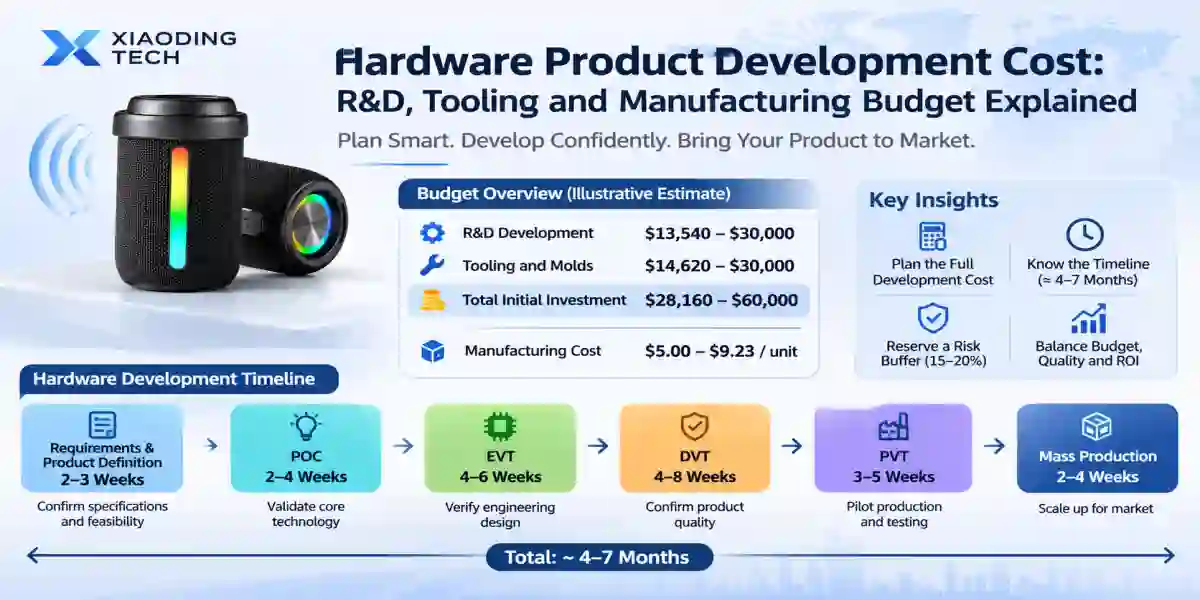
For an illustrative portable Bluetooth speaker project, the estimated initial investment could be:
| Cost Category | Illustrative Budget |
|---|---|
| R&D and Engineering | $13,540–$30,000 |
| Tooling and Molds | $14,620–$30,000 |
| Total Initial R&D and Tooling Investment | $28,160–$60,000 |
A relatively straightforward electronic hardware project may take approximately 4–7 months from confirmed product requirements through pilot production and initial mass-production ramp-up.
The main development stages are:
- Requirements and product definition
- Proof of Concept (POC)
- Engineering Validation Test (EVT)
- Design Validation Test (DVT)
- Production Validation Test (PVT)
- Mass production ramp-up
These figures are illustrative planning estimates, not formal quotations or guaranteed project schedules. Actual costs and timelines depend on the final product specifications, engineering requirements, validation results and manufacturing conditions.
1. What Determines Hardware Product Development Cost?
Hardware product development is more than designing a circuit board or assembling electronic components.
A complete project may involve:
- Product definition and technical feasibility analysis
- Industrial design and mechanical engineering
- Electronic hardware and PCB development
- Embedded firmware development
- Functional prototyping
- Tooling and mold development
- Engineering verification and reliability testing
- Manufacturing process preparation
- Supply chain coordination
- Pilot production and mass-production preparation
These activities require different engineering resources and happen at different stages.
For budget planning, it is useful to separate the project into three major cost categories:
| Cost Category | What It Covers |
|---|---|
| R&D and Engineering | Product design, electronics, firmware, mechanical engineering and prototyping |
| Tooling and Manufacturing Preparation | Custom molds, tooling, fixtures and production preparation |
| Manufacturing and Commercial Costs | Producción, quality control, packaging, logística, duties and other business expenses |
One important distinction: development investment is not the same as manufacturing cost.
A product may require substantial engineering and tooling investment before the first production order. A complete financial plan should consider both the upfront development budget and the working capital needed for manufacturing and delivery.
2. Example: Developing a 5W Portable Bluetooth Speaker
To make the cost and timeline easier to understand, let’s use an illustrative portable Bluetooth speaker project.
Example Product Specifications
| Item | Example Specification |
|---|---|
| Tipo de producto | Portable Bluetooth Speaker |
| Dimensions | 75 × 75 × 130 milímetros |
| Bluetooth | Bluetooth 5.3 |
| Wireless Range | Objetivo: approximately 15 m |
| Audio Output | 5W |
| Battery | 1,200mah |
| Water Resistance | IPX4 target |
| Housing | ABS, fabric mesh and silicone |
| Charging | USB Type-C |
| Additional Functions | TWS, TF card and hands-free calling |
| Lighting | RGB LED lighting |
| User Interface | 360-degree rotary volume control |
This product combines electronic engineering, acoustic design, mechanical development, firmware and custom enclosure design.
It is a useful example because it demonstrates why hardware development budgets need to cover more than electronic components.
The specifications are illustrative design targets, not verified test results or a confirmed XIAODING TECH customer project.
3. R&D and Engineering Development Cost
R&D is the investment required to turn a product idea into a functional and manufacturable design.
For the example Bluetooth speaker, an illustrative engineering budget is:
| Engineering Activity | Estimated Budget |
|---|---|
| Diseño Industrial (IDENTIFICACIÓN) | $2,310–$6,150 |
| Mechanical Design (Maryland) | $3,080–$6,150 |
| Hardware Development | $1,540–$3,080 |
| Firmware Development | $2,310–$4,620 |
| Acoustic Tuning | $770–$2,310 |
| Prototype Development | $1,230–$3,080 |
| Pre-testing and Assembly | $770–$1,540 |
| Project Management | $1,540–$3,080 |
| Estimated R&D Total | $13,540–$30,000 |
The main engineering activities include:
Diseño Industrial (IDENTIFICACIÓN)
Defines the product’s appearance, dimensions, materials, user experience and visual identity.
Mechanical Design (Maryland)
Develops the internal structure, enclosure, assembly method, mechanical interfaces and waterproofing approach.
Hardware Development
Covers circuit architecture, electronic design, PCB development, power management and hardware integration.
Firmware Development
Implements Bluetooth connectivity, audio functions, TWS, user controls, LED behavior and other embedded functions.
Prototype Development
Produces early samples to verify the engineering solution and identify design problems before tooling and production.
Testing and Assembly
Evaluates basic functionality, assembly feasibility and early engineering performance.
The actual R&D investment depends on product complexity, the number of custom functions, available reference designs and the amount of engineering work required.
4. Tooling and Mold Development Cost
For products with custom plastic or silicone housings, tooling can represent a significant part of the upfront investment.
The illustrative Bluetooth speaker may require several types of tooling:
| Tooling Activity | Estimated Budget |
|---|---|
| ABS Housing Mold | $10,770–$20,000 |
| LED Light Guide Mold | $1,540–$3,080 |
| Silicone Mold | $770–$2,310 |
| Mold Trial and Adjustment Reserve | $1,540–$4,620 |
| Estimated Tooling Total | $14,620–$30,000 |
Actual tooling costs depend on:
- Product dimensions and structural complexity
- Number of custom parts
- Mold material and expected production volume
- Surface finish and appearance requirements
- Mold cavities and production efficiency
- Mold trials and design revisions
A low initial tooling price does not necessarily mean a low total project cost.
Poor mold design can lead to repeated modifications, inconsistent product quality, assembly problems and production delays.
For this reason, tooling should be evaluated from both engineering and manufacturing perspectives.
5. Manufacturing Cost Planning: What Should Be Included?
After the product design and manufacturing process are sufficiently mature, the project can move toward mass production.
However, manufacturing cost should not be considered only as the cost of electronic components.
A complete manufacturing budget may include:
| Cost Area | What to Consider |
|---|---|
| Materials and Components | Electronic components, batteries, speakers, plastics and other materials |
| PCB and Electronics Production | PCB fabrication, SMT and electronic assembly |
| Mechanical Manufacturing | Plastic parts, silicone parts, metal parts and surface finishing |
| Product Assembly | Labor, assembly procedures and production fixtures |
| Testing and Quality Control | Functional testing, inspection and quality assurance |
| Packaging | Product packaging, accessories, labels and cartons |
| Production Yield | Material loss, rework and manufacturing defects |
| Logística | Shipping, insurance, warehousing and delivery |
The final manufacturing cost depends on production quantity, product specifications, supplier conditions, production yield, quality requirements and packaging.
Manufacturing Cost Is Not the Same as Landed Cost
For overseas brands and product companies, the factory manufacturing cost is only one part of the total commercial cost.
The landed cost may also include:
- International shipping
- Import duties and taxes
- Insurance
- Warehousing
- Local transportation
- Distribution expenses
- Other market-specific costs
When preparing a product business plan, these expenses should be considered alongside the development and manufacturing budgets.
A formal manufacturing quotation should be based on confirmed product specifications, production quantity, quality requirements and commercial terms.
6. Total Initial Investment: R&D and Tooling
Combining the illustrative R&D and tooling estimates gives the following initial development budget:
| Category | Estimated Budget |
|---|---|
| R&D and Engineering | $13,540–$30,000 |
| Tooling and Molds | $14,620–$30,000 |
| Total Initial Development Investment | $28,160–$60,000 |
This estimate represents the initial engineering and tooling investment for the example product.
It does not include all working capital required for mass production, inventory, proceso de dar un título, logística, marketing or distribution.
The actual funding requirement should be determined according to the final project scope, production plan and payment schedule.
7. Hardware Product Development Timeline: How Long Does It Take?
How long does it take to develop an electronic hardware product?
For a relatively straightforward product, the process may take approximately 4–7 months from confirmed requirements through pilot production and initial mass-production ramp-up.
The timeline depends on product complexity, engineering revisions, tooling requirements, component availability and validation results.
Hardware Development Timeline Overview
| Development Stage | Estimated Duration | Main Objective |
|---|---|---|
| Requirements and Product Definition | 2–3 weeks | Confirm product requirements and technical feasibility |
| POC | 2–4 weeks | Verify core technical functions |
| EVT | 4–6 weeks | Validate engineering design |
| DVT | 4–8 weeks | Validate the product design and performance |
| PVT | 3–5 weeks | Verify the production process |
| Mass Production Ramp-up | 2–4 weeks | Stabilize initial mass production |
<text>Estimated overall timeline: approximately 4–7 months.</text>
Some activities can overlap. For example, component sourcing, compliance preparation and tooling planning may begin before the previous engineering stage is completely finished, provided the technical risks are understood and controlled.
Stage 1: Requirements and Product Definition — 2–3 Weeks
The first stage is to turn the product idea into clear, actionable requirements.
Typical activities include:
- Confirming target users and application scenarios
- Defining product functions and technical specifications
- Reviewing product dimensions and design requirements
- Evaluating technical feasibility
- Identifying major engineering risks
- Establishing the initial development schedule and budget
Key deliverable: An agreed product requirements document and initial development plan.
Unclear requirements at this stage often lead to repeated design changes and unnecessary costs later.
Stage 2: POC — 2–4 Weeks
POC stands for Proof of Concept.
The purpose is to verify whether the core technical ideas can work before investing in full engineering development.
For the Bluetooth speaker, POC activities may include:
- Bluetooth connectivity verification
- Audio output and amplifier testing
- Battery and charging solution verification
- Initial LED function testing
- Preliminary firmware integration
Key deliverable: A functional proof-of-concept prototype demonstrating the feasibility of the main technical solution.
POC focuses on technical feasibility, not final appearance or mass-production readiness.
Stage 3: EVT — 4–6 Weeks
EVT stands for Engineering Validation Test.
At this stage, engineering samples are developed to evaluate whether the hardware, firmware and mechanical structure work together as intended.
Typical activities include:
- PCB design and debugging
- Firmware integration
- Mechanical structure verification
- Basic acoustic performance testing
- Power consumption evaluation
- Functional and preliminary reliability testing
Key deliverable: EVT samples, engineering test results and a list of design issues requiring correction.
Problems identified during EVT should be resolved before the project moves toward final tooling and design validation.
Stage 4: DVT — 4–8 Weeks
DVT stands for Design Validation Test.
The purpose is to verify whether the product design meets the intended requirements and is sufficiently mature for production preparation.
Activities may include:
- Testing samples made with production-intent tooling
- Mechanical fit and assembly verification
- Drop and vibration testing where applicable
- Charging and battery performance testing
- Water-resistance validation against the target specification
- Firmware stability testing
- Pre-compliance evaluation
Key deliverable: Design-validated samples and documented test results.
For the Bluetooth speaker example, the IPX4 target must be verified through appropriate testing. It should not be described as an achieved rating until the product has passed the required test.
Design changes during DVT can affect both tooling and schedule. Clear design review and approval criteria are therefore important.
Stage 5: PVT — 3–5 Weeks
PVT stands for Production Validation Test.
PVT evaluates whether the product can be manufactured consistently using the intended production process.
Typical activities include:
- Pilot production
- Assembly process verification
- Production fixture and test procedure validation
- Yield monitoring
- Quality inspection
- Packaging and labeling verification
- Work instruction finalization
Key deliverable: A pilot production report and a manufacturing process ready for mass-production approval.
The objective is to identify production problems before committing to larger manufacturing quantities.
Stage 6: Mass Production Ramp-up — 2–4 Weeks
After successful pilot production and the necessary approvals, the project can move into initial mass production.
The production team monitors:
- Production capacity
- Product consistency
- Assembly quality
- Functional test results
- Defect rates
- Component availability
- Delivery performance
Key deliverable: Initial mass-production output with controlled quality and production performance.
Production volume should increase in a controlled way rather than assuming that the first production run will immediately achieve stable full capacity.
8. What Can Delay a Hardware Development Project?
The estimated 4–7-month timeline is a planning reference, not a guaranteed delivery commitment.
Common causes of delay include:
| Risk Factor | Possible Impact |
|---|---|
| Unclear Product Requirements | Repeated design changes and additional engineering work |
| Critical Component Lead Times | Delays in prototype and production schedules |
| Mechanical Design Changes | Additional mold modifications and sample reviews |
| Engineering Test Failures | Extra debugging and validation cycles |
| Late Compliance Planning | Additional testing and possible redesign |
| Low Pilot Production Yield | More process adjustments before mass production |
| Delayed Customer Approvals | Longer decision and development cycles |
A realistic project schedule should include time for engineering revisions and validation instead of assuming every stage will pass on the first attempt.
The best way to control the schedule is to define clear deliverables, approval criteria and decision-making responsibilities before development begins.
9. How Should the Development Budget Be Allocated?
A hardware development budget should be released according to project milestones rather than spent without clear stage objectives.
The following percentages are illustrative planning references:
| Development Stage | Reference Budget Allocation |
|---|---|
| POC | 5–10% |
| EVT | 15–25% |
| DVT | 15–25% |
| PVT | 20–30% |
| Mass Production Launch | 25–40% |
These percentages are not universal rules and should not be added together as a fixed formula.
Actual allocation depends on the project structure, tooling payment terms, engineering workload, testing requirements and production quantity.
For example, a product requiring substantial custom tooling may need a larger portion of the budget before PVT.
The key principle is to connect project spending with measurable deliverables and approval milestones.
10. Cash Flow Planning and Contingency Reserve
A project budget should explain not only how much money is required, but also when payments need to be made.
Common cash-flow requirements include:
- Engineering service payments
- Prototype material and fabrication costs
- Tooling deposits and milestone payments
- Certification and testing expenses
- Production deposits
- Balance payments before shipment
- Inventory and logistics expenses
A reasonable planning approach is to maintain a contingency reserve of approximately 15–20% of the estimated project budget.
This reserve can help address unexpected engineering revisions, tooling adjustments, additional testing and supply chain changes.
For projects with longer development or sales cycles, founders should also consider working capital requirements over a rolling 12–18-month period.
11. Seven Common Hardware Development Budgeting Mistakes
1. Budgeting Only for Electronic Components
Components are only one part of the total development and manufacturing budget. Ingeniería, tooling, testing and production preparation also require investment.
2. Ignoring Engineering Fees
diseño industrial, mechanical engineering, PCB development, firmware and testing all require professional resources.
3. Underestimating Tooling Costs
Custom molds and tooling modifications can represent a significant upfront investment.
4. Starting Mass Production Before Validation
Skipping engineering validation can create expensive quality and manufacturing problems.
5. Ignoring Certification Requirements
Compliance requirements should be reviewed early according to the target market and product category.
6. Failing to Plan Cash Flow
A project can run out of working capital even when its total estimated budget appears sufficient.
7. Having No Contingency Reserve
Unexpected engineering changes, component shortages and testing failures can affect both project cost and schedule.
12. Hardware Product Development Checklist
Before starting a hardware development project, review the following:
Product requirements and target specifications are defined.
The main engineering solution has been evaluated.
R&D responsibilities and deliverables are clear.
Prototype quantities and validation requirements are defined.
Tooling requirements and ownership terms are understood.
Manufacturing cost assumptions are reviewed.
Production volume and MOQ assumptions are established.
Compliance requirements are identified.
Development milestones and estimated durations are agreed.
Payment milestones and cash-flow requirements are planned.
A contingency reserve is included.
Pilot production and mass-production acceptance criteria are defined.
13. Choosing an ODM Hardware Development Partner
For overseas brands, startups and product innovators, working with an ODM hardware development partner can help coordinate engineering, creación de prototipos, manufacturing preparation and supply chain activities.
XIAODING TECH is a Shenzhen-based electronic hardware product development and ODM partner providing integrated services from product definition and electronic engineering to prototyping, mechanical design, pruebas, supply chain coordination and mass production.
A structured development process helps customers understand:
- What needs to be developed
- Which engineering activities are required
- What the major development milestones are
- How long each stage may take
- What investment is required before production
- What needs to be validated before mass production
The objective is not simply to produce a working prototype. It is to develop a product that can be validated, manufactured and delivered according to the agreed requirements.
If you are planning a new electronic hardware product, defining the product requirements, target market, expected production quantity and technical priorities is a practical first step.
Contact XIAODING TECH to discuss your hardware product development requirements and evaluate a suitable engineering and manufacturing approach.
Frequently Asked Questions
1. How much does it cost to develop an electronic hardware product?
The cost depends on product complexity, engineering requirements, tooling, testing and production plans.
For the illustrative Bluetooth speaker in this article, the estimated initial R&D and tooling investment is approximately $28,160–$60,000.
This is a planning example, not a formal quotation. Actual project budgets must be evaluated against the confirmed product requirements and development scope.
2. How long does hardware product development take?
A relatively straightforward electronic hardware project may take approximately 4–7 months from confirmed product requirements through pilot production and initial mass-production ramp-up.
More complex products, additional certification requirements, major design changes and supply chain delays may extend the schedule.
3. What is the difference between EVT, DVT and PVT?
- EVT (Engineering Validation Test): Verifies whether the engineering design and core functions work.
- DVT (Design Validation Test): Verifies whether the product design meets the intended requirements.
- PVT (Production Validation Test): Verifies whether the product can be manufactured consistently using the intended production process.
These stages help reduce engineering and manufacturing risks before mass production.
4. Can tooling development happen at the same time as engineering development?
Some tooling planning and preparation can happen in parallel with engineering work.
However, releasing final tooling before the mechanical design is sufficiently mature can create expensive modification risks.
The appropriate timing depends on design maturity, product complexity and project risk.
5. Why does prototype production cost differ from mass production?
Prototype production often involves small quantities, manual assembly and special fabrication processes.
Mass production uses production tooling, optimized manufacturing processes, bulk purchasing and dedicated testing procedures.
The production cost and efficiency can therefore differ significantly from prototype manufacturing.
6. Should certification be included in the development budget?
Sí. Certification and compliance requirements should be evaluated according to the target market and product category.
The applicable requirements should be identified early because testing, documentation and design changes can affect both budget and schedule.
7. Is manufacturing cost the same as final landed cost?
No. Manufacturing cost is only one part of the total commercial cost.
International shipping, duties, taxes, insurance, warehousing, distribution and other expenses may need to be added to calculate the landed cost.
8. What information is needed before starting a hardware development project?
Useful starting information includes:
- Product concept and intended application
- Main functions and technical requirements
- Target market
- Industrial design references, if available
- Expected production quantity
- Target launch schedule
- Budget expectations
The more clearly these requirements are defined, the easier it is to evaluate the appropriate development scope and project schedule.
Conclusión
Hardware product development requires coordinated planning across engineering, tooling, manufacturing, validation and cash flow.
A realistic project budget should explain how much investment is required, when the money will be spent and what milestones it supports.
A realistic development timeline should connect each stage with specific engineering activities, deliverables and acceptance criteria.
For product founders and overseas brands, understanding these costs and timelines before starting development can reduce financial uncertainty, improve decision-making and help prevent avoidable project delays.
The goal is not simply to build a prototype. It is to develop a product that can be validated, manufactured and delivered successfully.
Si tiene creatividad sobre nuevos productos o próximos proyectos de desarrollo de hardware, no dude en contactarnos en cualquier momento!
Contacto: XIAODING
WhatsApp: +86-15013883553
Correo electrónico: contacto@xiaodingtech.cn
Organizaremos un equipo dedicado para realizar un seguimiento y evaluar su proyecto de manera profesional. Convirtamos juntos sus grandes ideas en productos electrónicos competitivos en el mercado.🚀
Disclaimer: All costs, durations and product specifications in the Bluetooth speaker example are illustrative planning assumptions. They are not formal quotations, guaranteed schedules, verified test results or confirmed XIAODING TECH customer project data. Actual costs and timelines must be evaluated according to the final product requirements, engineering scope, supplier conditions, testing results and production plan.