 XIAODING-TECNOLOGÍA

Introducción
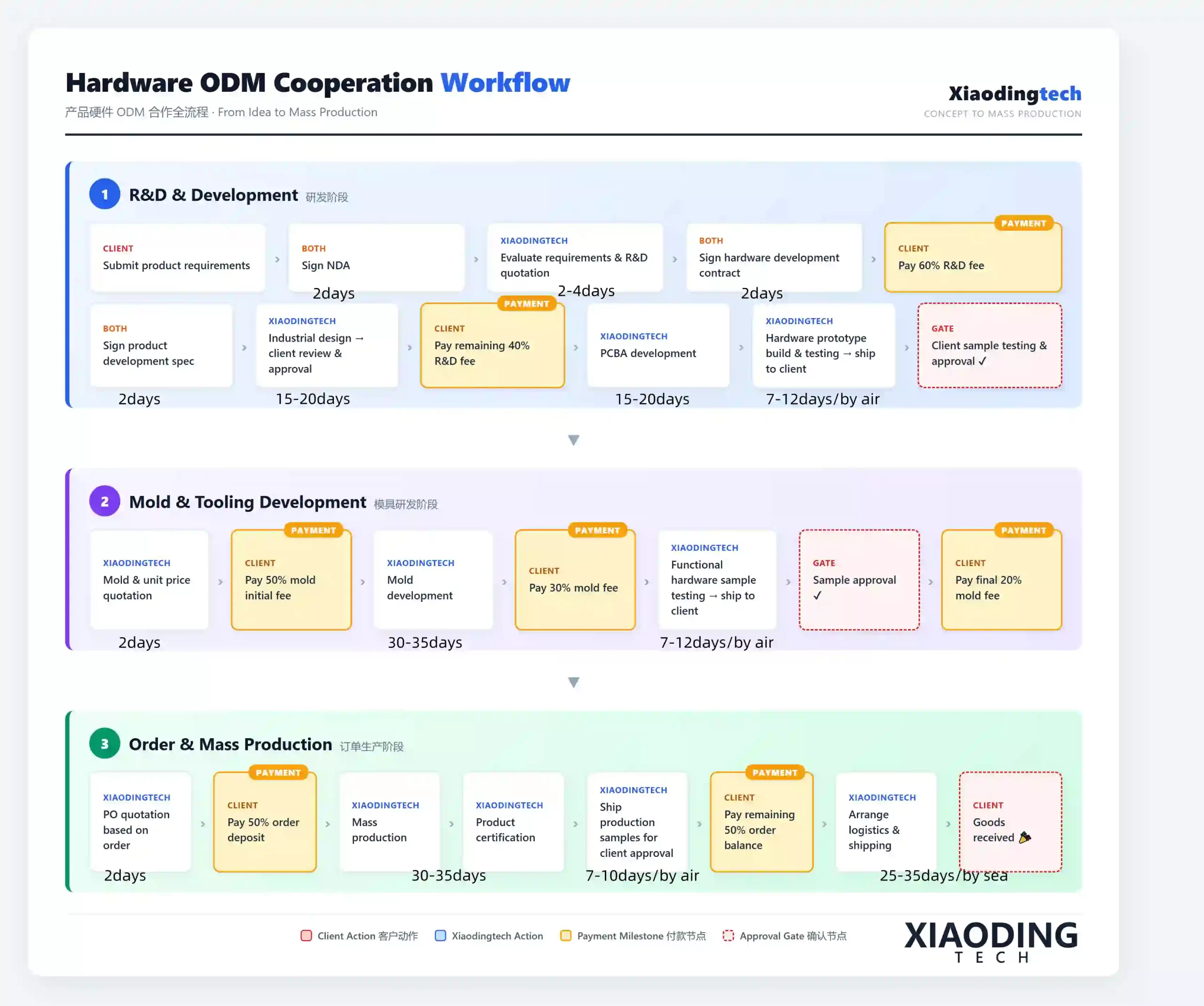
You have a hardware idea, but turning it into a product on your shelf requires industrial design, PCBA development, mold tooling, proceso de dar un título, and manufacturing. A hardware ODM (Fabricante de diseño original) partner owns that entire pipeline for you. At Xiaodingtech, our ODM process is structured around three transparent stages—R&D, tooling, and mass production—each tied to clear payment milestones and your approval. This guide explains exactly how it works.
What Is Hardware ODM?
Hardware ODM means a design and manufacturing company designs, engineers, and produces a product that you then sell under your own brand. Unlike OEM (where you provide the complete design), an ODM partner brings the engineering capability, supply chain, and production experience. You bring the product definition and market.
The 3-Stage Hardware ODM Process
Stage 1 — R&D & Product Development
The goal here is to prove the product works before cutting any metal.
- You submit your product requirements.
- Both parties sign an NDA (Non-Disclosure Agreement).
- The ODM partner evaluates requirements and provides an R&D quotation.
- You sign the hardware development contract and pay the 60% R&D deposit.
- Product development documentation is signed off.
- Industrial design begins; you review and approve the design.
- You pay the remaining 40% R&D fee.
- PCBA development, hardware prototype build, and internal testing follow.
- The prototype ships to you for validation.
- Approval gate: you test the sample and confirm it meets your spec.
Stage 2 — Mold & Tooling Development
Once the hardware prototype is approved, the product moves toward mass production.
- The ODM partner provides the mold quotation and unit price.
- You confirm pricing and pay the 50% mold initial fee.
- Mold development begins.
- On mold completion, you pay the 30% mold milestone.
- Functional hardware samples are built, tested, and shipped to you.
- Approval gate: you confirm the functional sample is acceptable.
- You pay the final 20% mold fee, releasing the project to production.
Stage 3 — Order & Producción en masa
- The ODM partner provides a purchase-order quotation based on your order volume.
- You pay the 50% order deposit.
- Mass production begins.
- Required product certifications are completed.
- Production samples are shipped for your final approval.
- Approval gate: you confirm production quality.
- You pay the remaining 50% order balance.
- The ODM partner arranges logistics and ships the goods to your destination.
Payment Milestones at a Glance
| Stage | Milestone | Payment |
|---|---|---|
| R&D | After contract signing | 60% |
| R&D | After design approval | 40% |
| Estampación | Mold kickoff | 50% |
| Estampación | Mold completion | 30% |
| Estampación | Functional sample approval | 20% |
| Producción | Order deposit | 50% |
| Producción | Pre-shipment balance | 50% |
Every payment is tied to a verified deliverable, and every gate requires your explicit sign-off.
ODM vs OEM: Which Do You Need?
- ODM is best if you have a product concept but lack in-house hardware engineering, tooling, or manufacturing teams.
- OEM is better if you already have a fully engineered design and only need a factory to build it.
If you want a partner that can take you from a blank page to a finished product on the shelf, ODM is the faster route.
Preguntas frecuentes
How long does the hardware ODM process take?
Timelines vary by product complexity, but typical R&D runs 6–12 weeks, mold tooling 4–8 weeks,
and mass production 4–8 weeks depending on order volume.
Who owns the design and IP?
This is defined in the development contract and NDA. At Xiaodingtech, we clarify IP ownership before R&D begins.
What certifications are handled?
Common certifications include CE, FCC, RoHS, UL, and regional safety approvals. Requirements depend on your target market.
Can I make design changes after mold opening?
Changes after tooling incur additional mold modification costs. Design changes are best locked during the R&D prototype stage.
Ready to Build Your Product?
Xiaodingtech supports hardware founders and brands from concept to mass production—covering industrial design,
tarjeta de circuito impreso, tooling, proceso de dar un título, y envío global.
Si tiene creatividad sobre nuevos productos o próximos proyectos de desarrollo de hardware, no dude en contactarnos en cualquier momento!
Contact us for a free project assessment.
Contacto: XIAODING
WhatsApp: +86-15013883553
Correo electrónico: contacto@xiaodingtech.cn
Sitio web oficial: www.xiaodingtech.cn
Organizaremos un equipo dedicado para realizar un seguimiento y evaluar su proyecto de manera profesional. Convirtamos juntos sus grandes ideas en productos electrónicos competitivos en el mercado.🚀