 XIAODING-TECH

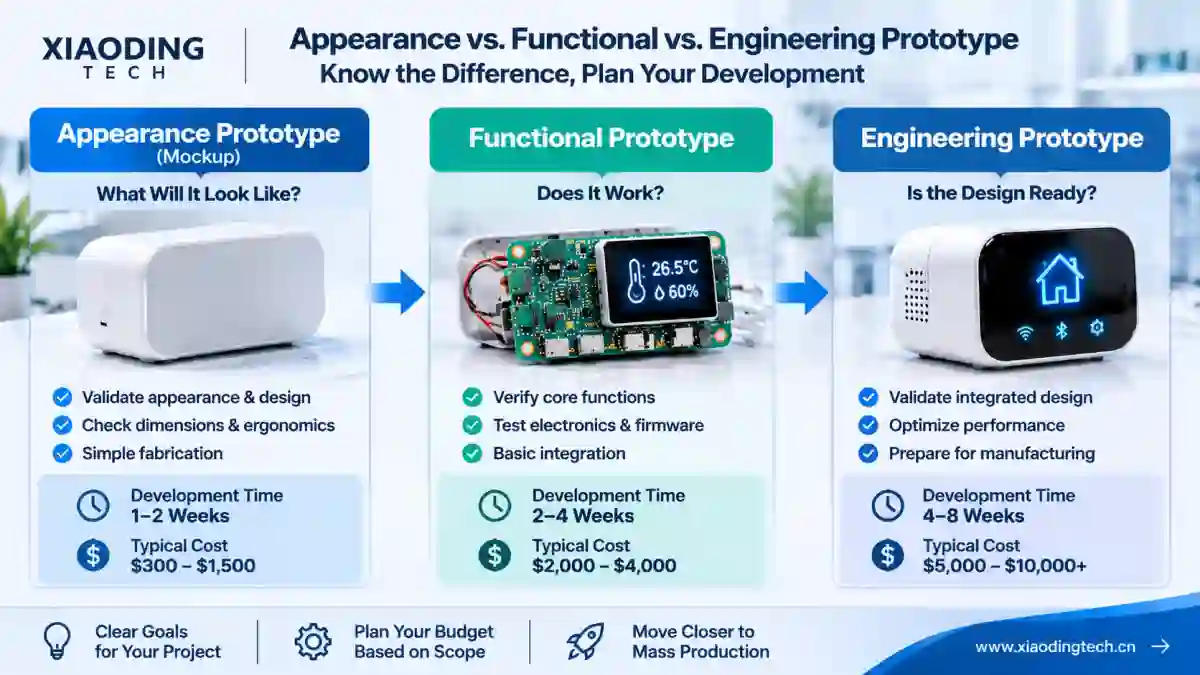
A Practical Guide for Hardware Startups, Product Founders, and Electronic Product Developers
When developing a new electronic product, one of the first decisions you need to make is what type of prototype to build.
Should you start with an appearance prototype, a functional prototype, or an engineering prototype?
These three terms are often used in hardware product development, but they describe different development objectives, engineering requirements, and deliverables.
Choosing the wrong prototype stage can waste time and money. For example, building an attractive physical model will not prove that your electronic system works. Similarly, a functional demonstration may not prove that the product’s mechanical structure is suitable for manufacturing.
The key difference is what each prototype is designed to validate:
- Appearance Prototype: What will the product look and feel like?
- Functional Prototype: Can the product perform its core functions?
- Engineering Prototype: Does the integrated product design meet the agreed engineering requirements?
This guide explains the differences, typical development timelines, engineering activities, expected deliverables, and how to choose the right prototype for your project.
Quick Comparison: Appearance vs. Functional vs. Engineering Prototype
| Comparison | Appearance Prototype | Functional Prototype | Engineering Prototype |
|---|---|---|---|
| Main purpose | Validate appearance and dimensions | Verify core functions | Validate integrated product design |
| Main question | What does it look like? | Does it work? | Does the design meet engineering requirements? |
| Mechanical structure | Basic or appearance-focused | Basic integration | More complete structural development |
| إلكترونيات | Usually not required | Required for relevant functions | Integrated according to project scope |
| البرامج الثابتة | Not required | Often required | Required when product functions depend on it |
| Testing | Appearance and dimensional checks | Functional checks | Agreed engineering validation |
| Typical development time | 1–2 weeks | 2– 4 أسابيع | 4– 8 أسابيع |
| Main result | Physical appearance model | Functional demonstration | Integrated engineering prototype |
The timelines above are preliminary planning references, not guaranteed delivery periods. Actual development time depends on product complexity, customization, component availability, engineering scope, and revision cycles.
Not every project needs all three stages separately. Some projects combine stages, while others require additional proof-of-concept work.
1. What Is an Appearance Prototype?
<text>An appearance prototype is a physical model used to evaluate a product’s external appearance, dimensions, and basic physical structure.</text>
Its primary purpose is to help product founders understand what the product will look and feel like before investing in more extensive engineering development.
An appearance prototype is usually focused on the enclosure and external design. It does not necessarily contain working electronics or functional firmware.
What Does an Appearance Prototype Validate?
An appearance prototype can help you evaluate:
- Product shape and proportions
- Overall dimensions
- Enclosure design
- Button and interface positions
- Basic assembly and physical fit
- User handling and ergonomics
- Surface finish and visual appearance
For example, if you are developing a new smart home device, you may first want to check whether the product is too large, whether the buttons are easy to reach, and whether the enclosure looks appropriate for your target market.
These questions can often be evaluated without developing the complete electronic system.
Common Manufacturing Methods
Appearance prototypes are commonly produced using:
- 3D printing
- CNC machining
- Basic surface finishing
- Simple mechanical assembly
The appropriate method depends on the required appearance, dimensions, material, accuracy, and budget.
Typical Development Time: 1–2 Weeks
<text color=”secondary” size=”xs”>Reference planning timeline</text>
A relatively simple appearance prototype may take around one to two weeks when the design information is available.
The schedule may increase if the design requires significant changes, complex surfaces, special materials, or multiple fabrication iterations.
Expected Deliverables
Depending on the agreed scope, an appearance prototype project may deliver:
- One or more physical appearance models
- Basic dimensional verification
- Appearance review feedback
- Initial structural observations
- Recommendations for design adjustments
When Should You Choose an Appearance Prototype?
An appearance prototype is suitable when:
- You have a product concept but need to review its physical form.
- You want to evaluate dimensions and proportions.
- You need a physical model for investor or customer presentations.
- You want to review the industrial design before functional development.
- You need to identify basic enclosure or ergonomic issues.
Important: An appearance prototype does not prove that the product’s electronic functions work. It should not be treated as a functional or production-ready sample.
2. What Is a Functional Prototype?
<text>A functional prototype is a working model developed to demonstrate and verify the core functions of an electronic product.</text>
Unlike an appearance prototype, a functional prototype focuses on technical feasibility.
Its purpose is to answer an important question:
Can the product perform the functions that the founder expects?
Depending on the product, the development may involve electronic components, sensors, development boards, custom PCB design, البرامج الثابتة, and basic mechanical integration.
What Does a Functional Prototype Validate?
A functional prototype may be used to verify:
- Whether the main electronic functions work
- Whether sensors can collect the required data
- Whether wireless communication operates as expected
- Whether the product can respond to user input
- Whether the display and control functions work
- Whether the power supply supports the intended operation
- Whether different electronic modules can communicate
For example, a smart environmental monitoring device may need to demonstrate:
- Temperature and humidity data collection.
- Data processing by a microcontroller.
- Display of measurement results.
- Wireless data transmission.
- Basic power management.
A functional prototype helps establish whether these essential functions can be achieved.
Common Engineering Activities
Depending on the project, functional prototype development may include:
- Electronic component selection
- Development board configuration
- Custom PCB design
- Sensor and module integration
- Firmware programming
- Basic enclosure integration
- Functional debugging
- Initial performance checks
Not every functional prototype requires a fully custom PCB. Existing development boards and mature modules may be appropriate for early technical verification.
Typical Development Time: 2–4 Weeks
<text color=”secondary” size=”xs”>Reference planning timeline</text>
A functional prototype may take around two to four weeks when the required functions and technical direction are reasonably clear.
The schedule depends on electronics complexity, firmware requirements, component availability, integration work, and debugging iterations.
Expected Deliverables
Depending on the agreed scope, a functional prototype project may deliver:
- A working prototype or demonstration unit
- Demonstration of agreed core functions
- Basic electronic integration
- Firmware implementation
- Functional test observations
- A list of identified technical issues
When Should You Choose a Functional Prototype?
A functional prototype is suitable when:
- You need to prove that the core technology works.
- You want to demonstrate the product’s main functions.
- You need to verify sensors, communication, or control systems.
- You want to evaluate technical feasibility before investing in full engineering development.
- You need an early demonstration for potential customers or investors.
Important: A functional prototype does not automatically prove product reliability, regulatory compliance, or mass-production readiness. Its purpose is to verify selected functions under agreed conditions.
3. What Is an Engineering Prototype?
It goes beyond demonstrating appearance or individual functions.
The goal is to integrate the major product systems into a more complete physical product and identify engineering issues before moving toward tooling and manufacturing.
An engineering prototype is particularly important for custom electronic products that involve mechanical structures, PCB development, البرامج الثابتة, and multiple integrated systems.
What Does an Engineering Prototype Validate?
Depending on the product and project scope, it may validate:
- Mechanical structure and component positioning
- PCB fit and internal layout
- Electronic and firmware integration
- Power management
- Thermal performance
- Mechanical and electronic compatibility
- Product assembly
- Functional performance
- Identified reliability risks
- Manufacturing feasibility
For example, a rechargeable smart device may work correctly on a development board but encounter problems when the electronics are installed inside the final enclosure.
The battery may not fit. The antenna may be affected by the enclosure. The device may generate too much heat. Buttons or connectors may be difficult to assemble.
An engineering prototype helps identify and address these issues.
Common Engineering Activities
Depending on the agreed development scope, engineering prototype development may include:
- Industrial and mechanical design
- Internal structural engineering
- Custom electronic circuit design
- PCB layout and assembly
- Firmware development and debugging
- Mechanical and electronic integration
- Prototype fabrication
- Functional testing and optimization
- Engineering documentation
- Manufacturing feasibility recommendations
Typical Development Time: 4–8 Weeks
An engineering prototype may take around four to eight weeks as an initial planning reference.
The actual schedule depends on the number of custom engineering tasks, product complexity, testing requirements, component lead times, and design revision cycles.
Expected Deliverables
Depending on the agreed scope, an engineering prototype project may deliver:
- Integrated engineering prototype
- Mechanical design outputs
- Electronic design outputs
- Firmware implementation
- Functional test records
- Identified engineering issues
- Design optimization recommendations
- Initial manufacturing feasibility assessment
- Engineering documentation
The specific files, source code, intellectual property ownership, and usage rights should be agreed in the development contract.
When Should You Choose an Engineering Prototype?
An engineering prototype is suitable when:
- Your product concept and main functions are defined.
- You need to integrate mechanical and electronic systems.
- Your product requires custom PCB and firmware development.
- You need to identify engineering problems before tooling.
- You are preparing for design validation and manufacturing.
- You want to establish a more complete product design.
Important: An engineering prototype is not automatically a certified or mass-production-ready product. Further design validation, reliability testing, compliance assessment, الأدوات, and pilot production may still be necessary.
4. What Is the Difference in Development Time?
Development time is an important consideration when planning a hardware project.
The following timelines can be used as preliminary planning references.
| Prototype type | Reference development time | Main work |
|---|---|---|
| Appearance Prototype | 1–2 weeks | Physical design and enclosure fabrication |
| Functional Prototype | 2– 4 أسابيع | إلكترونيات, البرامج الثابتة, and core function verification |
| Engineering Prototype | 4– 8 أسابيع | Mechanical and electronic integration, debugging, and engineering validation |
Why Does an Engineering Prototype Usually Take Longer?
An engineering prototype may involve several disciplines working together.
For example:
- Mechanical design needs to accommodate electronic components.
- PCB dimensions must match the internal structure.
- Firmware needs to work with the selected electronic components.
- Power consumption and thermal performance may need to be checked.
- Assembly problems may require mechanical modifications.
- Testing may identify issues that require another build.
The development team must coordinate these activities rather than simply fabricate a physical sample.
What Can Delay Prototype Development?
Common schedule risks include:
- Incomplete product requirements.
- Late changes to core functions.
- Unavailable electronic components.
- Custom PCB design and debugging.
- Mechanical structure revisions.
- Firmware changes.
- Additional testing requirements.
- Slow customer feedback or approval.
To improve project efficiency, define the prototype’s objectives and acceptance criteria before development begins.
5. Which Prototype Should You Choose for Your Product?
The right choice depends on what you need to prove at your current development stage.
Use the following examples as a guide.
Example A: A New Consumer Electronics Product
You have an idea for a new portable electronic device.
You know the general appearance but have not confirmed the internal structure.
Recommended approach:
Start with an appearance prototype to evaluate dimensions, enclosure shape, and product ergonomics.
Once the design direction is clear, move into functional development.
Example B: A Smart IoT Device
You want to develop a connected device with sensors, wireless communication, and a mobile interface.
You need to prove that the electronic system works.
Recommended approach:
Start with a functional prototype to verify sensor performance, communication, control logic, and power management.
The enclosure can be developed alongside the electronic system if appropriate.
Example C: A Custom Electronic Product Preparing for Manufacturing
You have confirmed the main functions and need to combine the mechanical structure, إلكترونيات, and firmware into an integrated product.
Recommended approach:
Develop an engineering prototype to verify system integration, assembly, and agreed engineering requirements before committing to production tooling.
A Simple Decision Guide
| Your current situation | Recommended prototype |
|---|---|
| I have an idea but need to see the physical product. | Appearance Prototype |
| I need to verify whether the main functions work. | Functional Prototype |
| I need to integrate the complete product design. | Engineering Prototype |
| I have an engineering prototype and need to prepare for production. | Design validation and manufacturing preparation |
Not every project needs to follow the same sequence. Some projects can combine appearance and functional development. Others may require a separate proof-of-concept before a complete engineering prototype.
The development plan should be based on the product’s technical risks and commercial objectives.
6. How Much Does Each Prototype Type Cost?
There is no universal price for appearance, functional, or engineering prototypes.
The cost depends on:
- Product complexity
- Design readiness
- Mechanical customization
- Electronic development requirements
- Firmware development
- Component and material costs
- Prototype fabrication methods
- Testing and validation
- Number of revisions
- Number of prototype units
For example, an appearance prototype based on completed 3D files may require mainly fabrication work.
A functional prototype may require electronic components, البرامج الثابتة, and debugging.
An engineering prototype may involve mechanical engineering, custom PCB development, firmware integration, fabrication, assembly, and testing.
These are different engineering scopes and should not be compared as equivalent services.
What Should You Compare in a Supplier Quotation?
Before choosing a supplier, ask:
- Which prototype type is included?
- What engineering work is included?
- Are mechanical design and enclosure fabrication included?
- Is PCB design included?
- Is firmware development included?
- How many prototype units will be delivered?
- What testing is included?
- How many revision rounds are included?
- What documents and design files will be delivered?
- What costs are excluded from the quotation?
The best quotation is not necessarily the cheapest one. It is the quotation that clearly matches your project objectives, engineering requirements, and expected deliverables.
7. What Happens After the Engineering Prototype?
Completing an engineering prototype is an important milestone, but it does not mean that the product is ready for mass production.
A typical development roadmap may continue as follows.
| Development stage | Main activities | Objective |
|---|---|---|
| Product definition | Requirements and feasibility review | Confirm project direction |
| Appearance development | Industrial design and physical model | Validate appearance |
| Functional development | Electronics and firmware | Verify core functions |
| Engineering development | System integration and optimization | Validate integrated design |
| Design validation | Performance, reliability, and compliance-related testing | Verify agreed requirements |
| Tooling and mold development | Mold design, fabrication, and sample inspection | Prepare production tooling |
| Pilot production | Trial manufacturing and process verification | Identify production issues |
| Mass production | Manufacturing and quality inspection | Deliver commercial products |
The sequence and duration depend on the product category, technical risks, tooling strategy, and validation requirements.
Why Is Design Validation Important Before Tooling?
Production molds and tooling can require significant investment.
If important mechanical or electronic issues remain unresolved, later changes may result in additional tooling costs and schedule delays.
Before approving tooling, consider whether:
- The mechanical structure has been reviewed.
- Internal components fit correctly.
- The PCB and enclosure are compatible.
- The assembly process has been considered.
- Important functional requirements have been verified.
- The design is suitable for the intended manufacturing process.
Tooling decisions should be supported by engineering evidence, not just by the appearance of a prototype.
8. Common Mistakes When Choosing a Prototype Type
Mistake 1: Thinking an Appearance Prototype Proves the Product Works
A physical model may look complete but contain no functional electronics.
Better approach: Clearly separate appearance validation from functional validation.
Mistake 2: Building a Functional Prototype Without Considering the Enclosure
Electronics may work on a development board but fail to fit inside the intended product structure.
Better approach: Consider mechanical and electronic integration early.
Mistake 3: Expecting a Functional Prototype to Be Production-Ready
A working demonstration does not automatically prove reliability, safety, compliance, or manufacturability.
Better approach: Plan additional engineering validation and production preparation.
Mistake 4: Choosing a Supplier Based Only on Prototype Price
A basic physical model and a fully integrated engineering prototype require very different work.
Better approach: Compare development scope, deliverables, اختبار, revisions, and responsibilities.
Mistake 5: Starting Production Tooling Too Early
Unresolved design problems may lead to expensive mold modifications.
Better approach: Establish clear design validation criteria before investing in production tooling.
9. How XIAODING TECH Supports Hardware Prototype Development
XIAODING TECH is an electronic hardware product development partner based in Shenzhen, الصين, supporting global product founders, startups, and brands.
With experience across more than 500 product cases, we support different stages of electronic hardware development.
Depending on project requirements, our services may include:
- Product concept and technical evaluation
- Industrial and mechanical design
- Electronic circuit and PCB development
- Firmware development
- Prototype fabrication and assembly
- Functional integration and debugging
- Engineering testing and optimization
- Supply-chain coordination
- Tooling and mass production preparation
Our objective is to help customers move from product concepts toward integrated engineering solutions and manufacturing preparation.
What Types of Projects Are a Good Fit?
We are most interested in projects with:
- A clearly defined product concept
- Basic functional requirements
- A target customer group or application scenario
- A realistic development budget
- A reasonable project timeline
- A clear plan for commercial development
- An intention to continue toward tooling, pilot production, or mass production
We value long-term cooperation and believe successful hardware development requires close communication between the customer and engineering team.
How Does the Project Evaluation Process Work?
Step 1 – Submit Your Project Information
Provide your product concept, reference images, main functions, target market, and expected development schedule.
Step 2 – Initial Project Review
We review the available information and identify key technical questions and development requirements.
Step 3 – Technical Communication
Both sides clarify the development scope, technical challenges, prototype objectives, and expected deliverables.
Step 4 – Development Quotation
A quotation is prepared based on the agreed scope, assumptions, deliverables, and estimated schedule.
Step 5 – Development Agreement
Once both sides agree on the technical and commercial terms, engineering work can begin.
A preliminary discussion is not a complete engineering assessment. Detailed evaluation and quotation depend on the information provided and the agreed project scope.
10. Ready to Choose the Right Prototype for Your Product?
Before requesting a prototype quotation, ask yourself three questions:
- What do I need to validate at this stage?
- What engineering work is required to achieve that objective?
- What should happen after the prototype is completed?
The answers will help you choose the right development stage and avoid unnecessary costs.
XIAODING TECH welcomes project inquiries from global hardware entrepreneurs, startups, and product brands looking for an electronic hardware development partner in Shenzhen, الصين.
To help us understand your project, please prepare:
- Product concept or reference images
- Main functions and technical requirements
- Target application and customer group
- Expected prototype quantity
- Target development schedule
- Estimated project budget
- Your plan after prototype validation
Let’s turn your product idea into an engineered product with a clear path toward manufacturing.
Visit:https://www.xiaodingtech.cn/free-evaluation-for-consumer-electronics-innovation-projects/
الأسئلة المتداولة
1. What is the difference between an appearance prototype and a functional prototype?
An appearance prototype is used to evaluate the product’s external appearance, dimensions, and physical structure. A functional prototype is designed to demonstrate and verify the product’s core functions, which may involve electronic components, PCB development, and firmware.
2. What is the difference between a functional prototype and an engineering prototype?
A functional prototype focuses on verifying selected product functions. An engineering prototype integrates mechanical, electronic, and software systems to evaluate whether the overall design meets agreed engineering requirements.
3. How long does it take to build an appearance prototype?
As an initial planning reference, an appearance prototype may take around 1–2 weeks. The actual schedule depends on design readiness, fabrication methods, structural complexity, and revisions.
4. How long does functional prototype development take?
A functional prototype may take around 2–4 weeks as a planning reference. Electronics complexity, firmware requirements, component availability, and debugging can affect the schedule.
5. How long does an engineering prototype take?
An engineering prototype may take around 4–8 weeks as a preliminary planning reference. Projects involving complex mechanical structures, custom electronics, البرامج الثابتة, and multiple revisions may require more time.
6. Do all electronic products need all three prototype stages?
No. Some projects can combine appearance and functional development, while others require additional proof-of-concept work or several engineering iterations. The right sequence depends on the product’s technical risks and development objectives.
7. Does an engineering prototype mean the product is ready for mass production?
No. An engineering prototype is used to evaluate the integrated product design. Additional design validation, reliability testing, compliance assessment, الأدوات, and pilot production may still be required.
8. Should I choose the cheapest prototype supplier?
Not based on price alone. Compare the engineering scope, deliverables, اختبار, revision policy, communication, and relevant product experience. A lower quotation may cover only a limited part of the development work.
9. What information should I prepare before requesting a prototype quotation?
Prepare your product concept, main functions, reference images, approximate dimensions, power and connectivity requirements, target market, expected prototype quantity, schedule, and estimated budget.
10. Can XIAODING TECH support development from prototype to mass production?
Depending on the project scope, XIAODING TECH can support product evaluation, mechanical and electronic development, البرامج الثابتة, prototype fabrication, engineering validation, supply-chain coordination, and manufacturing preparation.
ملاحظة:
إذا كان لديك أي إبداع منتج جديد أو مشاريع تطوير الأجهزة القادمة, لا تتردد في الاتصال بنا في أي وقت!
اتصال: شياو دينغ
واتساب: +86-15013883553
بريد إلكتروني: contact@xiaodingtech.cn
سنقوم بترتيب فريق متخصص لمتابعة وتقييم مشروعك بشكل احترافي. دعنا نحول أفكارك الرائعة إلى منتجات إلكترونية قادرة على المنافسة في السوق معًا.🚀
XIAODING TECH — Your Hardware Product Development Partner in Shenzhen, الصين.

واتساب
قم بمسح رمز QR Code لبدء محادثة WhatsApp معنا.